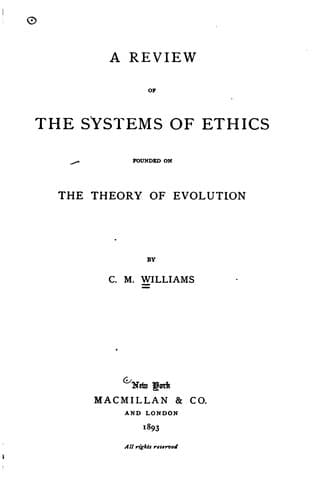
A Review of the Systems of Ethics Founded on the Theory of EvolutionWilliams, Cora May
Philosophy
A Review of the Systems of Ethics Founded on the Theory of Evolution
Williams, Cora May
Ethics, Evolutionary
Through the conditions of the earth's atmosphere, man has grown to be
the glorious creature that he is. If we gradually give him, by
education, an advantageous love of life and pleasure therein, and at the
same time do not neglect the cultivation of ethical principles, virtue
will become, with the increase of happiness, a necessity.
If intelligence is to bear the fruit which we thus demand of it, its
nature must be such as not only to be nourished by actual life, but also
to uplift by its increase the whole man. And this is, in fact, the case;
where it is not so, we have to do with a one-sided development such as
existing circumstances often condition, but which cannot be regarded as
normal. This point of view is the necessary consequence of the unity
which we postulate of man. If thought and will have their origin in
feeling, and if will clarifies itself through the clarification of
thought, then all advance in thought leads, in general, to an advance in
feeling, and true intelligence is inseparable from true love. We use the
word "love" here, as designating intelligence in its highest sense, and
declare, moreover, that we would desire to see this meaning alone
attached to love. Over against the conception of love which we find in
Hartmann and Schopenhauer, we place the conception of Spinoza, who
designates it as a free, reasonable activity, and says of it as
distinguished from passion that "the love of both man and wife has for
its cause, not a pleasing exterior merely, but especially freedom of
soul."
Public-domain text, read in full here on John Shaqi.
Reviews
Reviews
No reviews yet
Be the first to share your thoughts on this work.
Elsewhere in the archive
Join the Discussion
Join the discussion
Sign in to leave a comment or review.
Sign InorCreate an account