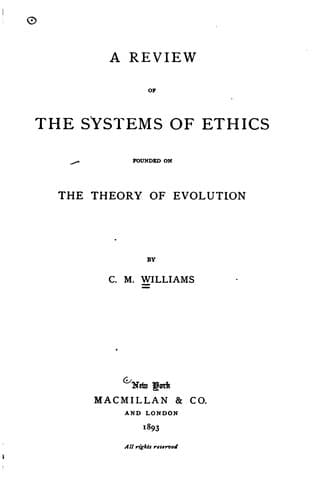
A Review of the Systems of Ethics Founded on the Theory of EvolutionWilliams, Cora May
Philosophy
A Review of the Systems of Ethics Founded on the Theory of Evolution
Williams, Cora May
Ethics, Evolutionary
If we regard intelligence and love in their highest antithesis, the one
appears as the appropriative, the other as the self-devoting conception
of things. But since we form a conception of things and make them our
own only in proportion to our intelligence, our attitude towards them
must be according to this measure; and since there is no action without
reaction, intelligence must be broadened by love as well as love
clarified by intelligence. The highest of all is intelligence; but it is
love that first lends it creative power; without love it cannot create,
but only destroy. Everything great and noble that man can point out as
his work is due to love--love of mankind, love of country, love of
knowledge, love of art, love of labor in general. If the devotion is
deficient in purity, determined by extraneous motives, the work will
bear marks of the deficiency. The reason why the power of love is so
much greater than every other power is that its all-embracing, boundless
character reacts upon it as a feeling of eternity, enabling it to
undertake all things, as if it might conquer even death. Life,
considered in its parts, is cheerless; but love, regarding it in its
totality, points out to it the way of salvation through itself. Love is
the concrete element which exalts the abstraction of Intelligence to
incarnate Idea; therefore is love the idealizing principle from which
intelligence draws belief in its own aims. And if one questions whence
comes the conception of immortality, impossible to be won from
experience, love must confess itself guilty of originating it, being
unable, to exist without this self-delusion.
Carneri thus places himself in direct opposition to Schopenhauer's and
Hartmann's notion of love, which, he says, "falls like a deep shadow
over their whole conception of the world"; and he pleads in favor of a
standpoint which shall make self-perfection the aim of existence for
woman as for man. He propounds a theory of education for woman which,
according to his own statement, places him at one in spirit with Mill;
but he avers that he cannot follow the latter in his more extreme views,
which, he says, were evidently assumed by Mill only in view of the
strength of the enemy with which he had to contend. The book ends with
the following paragraph:--
Public-domain text, read in full here on John Shaqi.
Reviews
Reviews
No reviews yet
Be the first to share your thoughts on this work.
Elsewhere in the archive
Join the Discussion
Join the discussion
Sign in to leave a comment or review.
Sign InorCreate an account