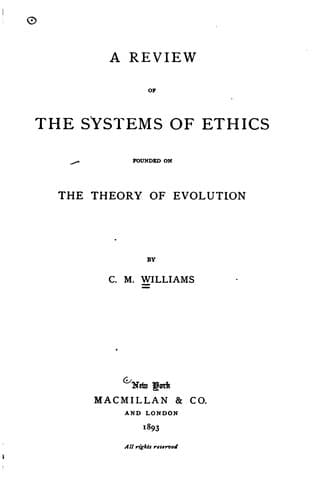
A Review of the Systems of Ethics Founded on the Theory of EvolutionWilliams, Cora May
Philosophy
A Review of the Systems of Ethics Founded on the Theory of Evolution
Williams, Cora May
Ethics, Evolutionary
"We do not run after ideals; hence no plan floats before us, according
to which the world should be shaped anew. He who understands how to read
the book of History knows that, in no one place does the identity of
form and content come more clearly into view than in others, and that,
with every new content, there is always a new form also. The modern
state has by no means outlived itself yet, and those who endeavor to do
away with it know not what they are about. Instead of thinking upon a
new form, let us devote our care to the clarification of the content. No
one deceives himself as to the suffering in the world; but he deceives
himself who thinks that he alone can bring about a better condition.
Only the action of all can better things. Therefore, that which remains
for us to do can be summed up in these few words: _Let us make every
effort possible to place every one in a position to help himself._ This
is the only ethical conception of universal reform. Let us prize
knowledge above all things, and let us show that we so prize it by
increasing it and diffusing it as much as lies in our power; let us
prize it above all things, and prove that we do so by using it for the
good of mankind. By knowledge we have become human beings, because
knowledge has brought us to a comprehension of the Beautiful and the
Good. It is knowledge that sets life an end in the attainment of the
Good, and knowledge that glorifies our path to that end. Let us educate
for ourselves wives that shall not merely dimly feel what we think, but
such as will bring to the execution of our will a clear understanding.
Let us educate for ourselves wives who, fired by the same feelings as
our own, will unite their efforts with ours in the education of a
generation that shall take _morally_ the stand upon which the science of
the century finds itself. Let us seek true happiness if we would find
virtue. It is to no wisdom, but it is likewise to no foolishness that we
owe the existence of the world. Man can be foolish; but he can also be
wise; and if he is wise, then the world too is wisely arranged."
Carneri begins his "First Principles of Ethics" ("Grundlegung der
Ethik," 1881) with an investigation of the origin of primary concepts
and our knowledge through these. In order to bring light into our
conception, we must first of all learn the way to the concept; for then
only can we see how the concept completes itself in the judgment, and
becomes, in reasoning, the criterion of its own worth.
Public-domain text, read in full here on John Shaqi.
Reviews
Reviews
No reviews yet
Be the first to share your thoughts on this work.
Elsewhere in the archive
Join the Discussion
Join the discussion
Sign in to leave a comment or review.
Sign InorCreate an account