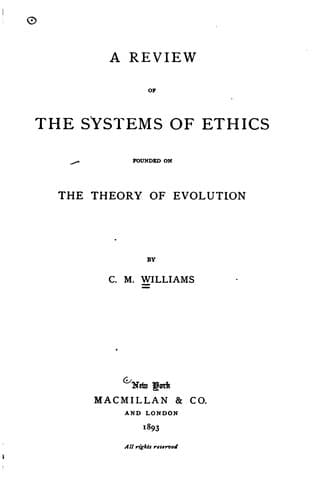
A Review of the Systems of Ethics Founded on the Theory of EvolutionWilliams, Cora May
Philosophy
A Review of the Systems of Ethics Founded on the Theory of Evolution
Williams, Cora May
Ethics, Evolutionary
indifferent about a stranger; a young and timid mother urged by the
maternal instinct will, without a moment's hesitation, run the greatest
danger for her own infant, but not for a mere fellow-creature.
Nevertheless, many a civilized man, or even boy, who never before risked
his life for another, but full of courage and sympathy, has disregarded
the instinct of self-preservation, and plunged at once into a torrent to
save a drowning man, though a stranger.... Such actions as the above
appear to be the simple result of the greater strength of the social or
maternal instincts than that of any other instinct or motive; for they
are performed too instantaneously for reflection, or for pleasure or
pain to be felt at the time; though, if prevented by any cause, distress
or even misery might be felt.... I am aware that some persons maintain
that actions performed impulsively, as in the above cases, do not come
under the dominion of the moral sense, and cannot be called moral.... On
the contrary, we all feel that an act cannot be considered as perfect or
as performed in the most noble manner, unless it be done impulsively,
without deliberation or effort, in the same manner as by a man in whom
the requisite qualities are innate." Darwin defines the office of the
moral sense as "telling us what to do,"[14] that of conscience,--which
includes remorse, repentance, regret or shame, fear of the gods and of
the disapprobation of men,--as reproving us if we disobey it;[15]
conscience seems elsewhere to be defined as concerned with resolve to
better future action; and in still another passage, the moral sense and
conscience are identified. But again, in another paragraph, Darwin seems
to ascribe remorse or regret, not to the baulking of an instinct, but to
a _judgment_ of having been baulked: "A man cannot prevent past
impressions often repassing through his mind; he will thus be driven to
make a comparison between the impressions of past hunger, vengeance
satisfied, or danger shunned at other men's cost, with the almost
ever-present instinct of sympathy, and with his early knowledge of what
others consider as praiseworthy or blamable. This knowledge cannot be
banished from his mind, and from instinctive sympathy is esteemed of
great moment. He will then feel as if he had been baulked in following a
present instinct or habit, and this with all animals causes
dissatisfaction, or even misery."[16] But, in spite of all
indefiniteness in the use of terms and uncertainty as to the
interrelations of "the social instincts," sympathy, reason, pleasure,
and the moral sense, it is, after all, comparatively easy to gather,
after a little deeper study, the general and more important features of
Darwin's theory as to the origin of morality. We may state these as
follows: The social instinct led men or their ape-like progenitors to
society,[17] this instinct growing out of the parental or filial
affections through habit and natural selection. Virtue is, at first,
Public-domain text, read in full here on John Shaqi.
Reviews
Reviews
No reviews yet
Be the first to share your thoughts on this work.
Join the Discussion
Join the discussion
Sign in to leave a comment or review.
Sign InorCreate an account