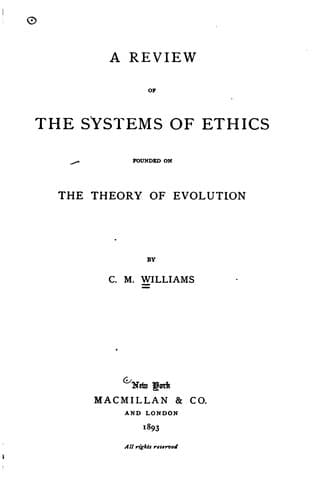
A Review of the Systems of Ethics Founded on the Theory of EvolutionWilliams, Cora May
Philosophy
A Review of the Systems of Ethics Founded on the Theory of Evolution
Williams, Cora May
Ethics, Evolutionary
only tribal.[18] The social qualities of sympathy, fidelity, and courage
implied in mutual aid and defence, were no doubt acquired by man through
the same means. "When two tribes of primeval man, living in the same
country, came into competition, if (other circumstances being equal) the
one tribe included a great number of courageous, sympathetic, and
faithful members, who were always ready to warn each other of danger, to
aid and defend each other, this tribe would succeed better and conquer
the other.... Selfish and contentious people will not cohere, and
without coherence nothing can be effected. A tribe rich in the above
qualities would spread and be victorious over other tribes; but in the
course of time it would, judging from all past history, be in its turn
overcome by some other tribe still more highly endowed. Thus the social
and moral qualities would tend slowly to advance and be diffused
throughout the world." Though in a warlike state, where courage is
especially necessary to tribal existence, the bravest men would perish
in larger numbers than other men, and the survival of the unfittest
would seem thus to be secured, the influence of their bravery on others
might excite the latter to imitation and do far more good than the
begetting of offspring who would inherit their bravery. So, also, pity,
though inciting modern society to the preservation of the weak, yet is
useful in that it cultivates sympathy; and so, too, wealth, affording
leisure for intellectual pursuits and a wider choice in marriage, tends,
in the end, to the preservation of the fittest morally, by direct or
indirect means.[19] Altruistic action, followed from selfish motives,
may become habit; habits of benevolence certainly strengthen the feeling
of sympathy; and "habits followed during many generations probably tend
to be inherited." Furthermore, melancholy tends often to suicide, as
violence, and quarrelsomeness to a bloody end, intemperance to the
destruction of individual life, and profligacy to disease and sterility;
so that some elimination of the worst dispositions takes place. These
are some of the probable steps of advancement, though the process is
too complex to be clearly followed out. The approbation of
others--the strengthening of sympathies by habit--example and
imitation--reason--experience and even self-interest--instruction during
youth, and religious feelings--are the causes which lead to the
advancement of morality.[20] In the paragraph just quoted, Darwin says:
"With civilized nations, as far as an advanced standard of morality and
an increased number of fairly good men are concerned, natural selection
apparently effects but little, though the fundamental social instincts
were originally thus gained"; but he later writes: "Judging from all
that we know of man and the lower animals, there has always been
sufficient variability in their intellectual and moral faculties for a
steady advance through natural selection"; and he further says: "No
Public-domain text, read in full here on John Shaqi.
Reviews
Reviews
No reviews yet
Be the first to share your thoughts on this work.
Join the Discussion
Join the discussion
Sign in to leave a comment or review.
Sign InorCreate an account