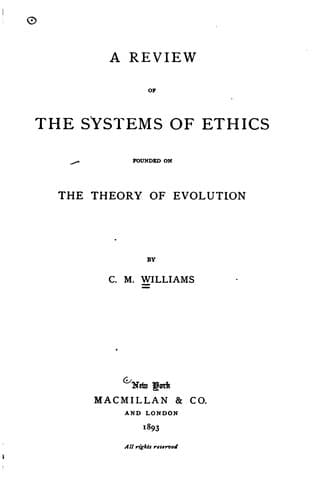
A Review of the Systems of Ethics Founded on the Theory of EvolutionWilliams, Cora May
Philosophy
A Review of the Systems of Ethics Founded on the Theory of Evolution
Williams, Cora May
Ethics, Evolutionary
doubt such advance demands many favorable concurrent circumstances; but
it may well be doubted whether the most favorable would have sufficed,
had not the rate of increase been rapid, and the consequent struggle for
existence extremely severe."[21] The end or aim of morality is the
general good, rather than the general happiness, though "no doubt the
welfare and the happiness of the individual usually coincide; and a
contented, happy tribe will flourish better than one that is
discontented and unhappy.... As all wish for happiness, the 'greatest
happiness principle' will have become a most important secondary guide
and object; the social instinct, however, together with sympathy (which
leads to our regarding the approbation and disapprobation of others),
having served as the primary impulse and guide."[22] And with regard to
the future, Darwin says: "Looking to future generations, there is no
cause to fear that the social instincts will grow weaker, and we may
expect that virtuous habits will grow stronger, becoming perhaps fixed
by inheritance. In this case the struggle between our higher and lower
impulses will be less severe, and virtue will be triumphant."[23]
FOOTNOTES:
[1] P. 381. This essay originally formed part of the chapter on
"Instinct" in "The Origin of Species," but was omitted for the sake of
condensation.
[2] Vol. I. p. 319.
[3] Pp. 320, 321.
[4] Appendix to "Mental Evolution in Animals," pp. 378, 379. The italics
are my own.
[5] "The Origin of Species," II. p. 286.
[6] Ibid. I. pp. 353, 354.
[7] "The Origin of Species," I. pp. 321, 322.
[8] Ibid. I. pp. 12-17.
[9] Appendix to "Mental Evolution in Animals," pp. 370, 383; see also
"The Descent of Man," I. p. 102 _et seq._; and "Nature" for Feb. 13,
1873, introduction to a letter to the editor from William Higginson.
[10] P. 103.
[11] Pp. 160, 161.
[12] P. 161.
[13] See also p. 171. And, p. 172, sympathy is designated as "a
fundamental element of the social instincts."
[14] P. 178.
[15] Pp. 174, 178.
[16] P. 173.
[17] "Descent of Man," I. p. 199, etc.
[18] Ibid. p. 179.
[19] Ibid. pp. 199-209.
[20] Ibid. p. 212.
[21] Ibid. pp. 219, 220.
[22] Ibid. p. 185.
[23] Ibid. p. 192.
ALFRED RUSSEL WALLACE
Public-domain text, read in full here on John Shaqi.
Reviews
Reviews
No reviews yet
Be the first to share your thoughts on this work.
Join the Discussion
Join the discussion
Sign in to leave a comment or review.
Sign InorCreate an account