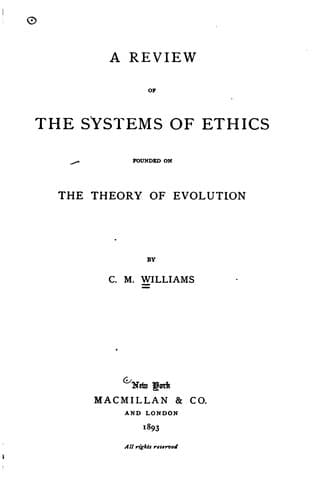
A Review of the Systems of Ethics Founded on the Theory of EvolutionWilliams, Cora May
Philosophy
A Review of the Systems of Ethics Founded on the Theory of Evolution
Williams, Cora May
Ethics, Evolutionary
And here we may perceive the possibility of a standpoint upon which all
judgment is dispensed with. Such a standpoint is represented by
Aristippus of Cyrene, who asserts the sovereignty of the moment. It is
not without its justification. Ethics itself must show cause for the
relinquishment of the satisfaction of the moment in favor of other
moments.
If the principle of the sovereignty of the moment could be practically
carried out, no reasoning could overthrow it. However, there can
scarcely be a conscious individual in whom there are not instincts and
impulses which reach beyond the moment. When a momentary state of
feeling, as the effect of an act of the subject, comes together in
consciousness with the feeling determined by the conception of the life
as totality (the result of memory and comparison), a new feeling arises
which is either one of harmony or one of discord. The standard by which
judgment is pronounced is determined by this feeling. The capacity for
such feelings is conscience, as this may manifest itself in entirely
isolated individuals. Conscience, in the broadest sense of the word, is
a feeling of relations, and requires only a relation between central and
peripheral feelings,--feelings of wider, and feelings of narrower
thought-connection. The single moment and the single act are judged
according to their worth as parts of the individual life as totality.
And here the individual is confronted by the necessity of bringing the
single parts of his life into harmony. The problem is certainly never
solved by any individual involuntarily. The estimation of earlier acts
according to the assistance they give in this task is, therefore, at
this point, of great importance to the individual. The judgment
pronounced is thus not only made possible through the central feeling
which corresponds to the life as totality, but is determined by it. An
acute sense for that which benefits the individual life whose single
members are the moments, is a condition of the continuance and
development of the life; it is a higher sort of instinct of
self-preservation, and need not be confined to the continuance of
physical life, but may also refer to the ideal needs.
And here we come upon the standpoint of Individualistic Ethics. From
such a standpoint, the problem is to determine, not only how much energy
may be used in the single moments of time, but also in what manner it
should be used in order to secure as great variety and many-sidedness as
may be consistent with the interests of the life as totality. Nor are
the interests of the life to be summed up in physical self-preservation;
the individual acquires, in the natural course of things, interests of
increased ideality and complexity, through which the life gains in
content.
Public-domain text, read in full here on John Shaqi.
Reviews
Reviews
No reviews yet
Be the first to share your thoughts on this work.
Elsewhere in the archive
Join the Discussion
Join the discussion
Sign in to leave a comment or review.
Sign InorCreate an account