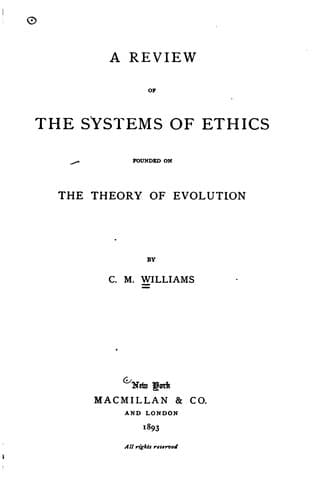
A Review of the Systems of Ethics Founded on the Theory of EvolutionWilliams, Cora May
Philosophy
A Review of the Systems of Ethics Founded on the Theory of Evolution
Williams, Cora May
Ethics, Evolutionary
The ethical law, from the standpoint of Individualism, is expressed by a
formula which requires harmonious relation between the interest of the
life as totality and the impulse of the moment; it consists of two chief
mandates: (1) The single instant should have no greater independence
than corresponds to its significance in the life as totality; (2) but,
on the other hand, the single moments should be as richly and intensely
lived as is consistent with the preservation of the life's totality.
Of Individualism, or the principle of the Sovereignty of the Individual,
the same is true as of the sovereignty of the moment, that no reasoning
can overthrow it; if the individual recognizes no end but his own life,
there is no logical way of transition to another standpoint. A change of
aim can take place only through such a change in the central feelings
which determine the standard of the individual that a wider circle of
conceptions enter into his reflections. Until this takes place, there is
no use in appealing to conscience.
The science of Ethics has often claimed to be a science of pure reason.
This claim is opposed to its character as a practical science, since
action can be judged only according to the ends it had in view, and ends
presuppose feelings of pain and pleasure. On the other hand, there is,
in the mere capacity for pain and pleasure, no limitation of the extent
of the circle of conceptions with which the feelings of pain and
pleasure are connected.
Individualism can be carried out in practice only approximately; the
individual has his origin in the species, and lives his whole life as a
part of the life of his kind, with an organization in which the results
of the action and passion of earlier generations are inherited, and in a
mental atmosphere which has induced the development of his species. And
just as the instinct of self-preservation did away with the isolation of
the single moments of the individual life, becoming, thus, the basis of
feelings determined by the interests of the life as totality, so the
sympathetic instincts do away with the isolation of the single
individuals and determine the conditions of the life of the species in
the minds of its individuals. The most primitive form of the sympathetic
instincts is exhibited in the family. Here, however loose and variable
the relation of man and wife may be, that of mother and child cannot, by
its nature, be done away with or essentially changed. In this case, the
sympathetic feeling springs immediately from the natural instinct, and
the relation is the nucleus which makes possible the higher forms of
family life. In the family circle, the sympathetic feelings are
cultivated, and arrive at such strength that they come to include ever
wider and wider circles of human beings. Indeed, the mother-love remains
forever the image and criterion of all sympathy, as well in respect to
strength as to purity.
Public-domain text, read in full here on John Shaqi.
Reviews
Reviews
No reviews yet
Be the first to share your thoughts on this work.
Elsewhere in the archive
Join the Discussion
Join the discussion
Sign in to leave a comment or review.
Sign InorCreate an account