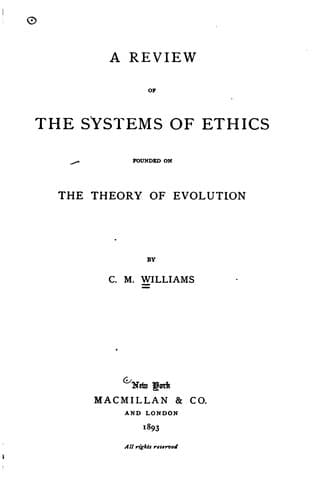
A Review of the Systems of Ethics Founded on the Theory of EvolutionWilliams, Cora May
Philosophy
A Review of the Systems of Ethics Founded on the Theory of Evolution
Williams, Cora May
Ethics, Evolutionary
When sympathy has reached full purity, it is a feeling of pain or
pleasure determined by the fact that other beings feel pain or pleasure.
The most important point of its development was when it so broadened as
to include all mankind. The Peripatetic and the Stoic schools of Greek
philosophy led to this idea of love to all humanity and the natural
union of all men in one great society. But this idea acquired greater
historic importance when it became a chief commandment of a great
religion,--of Christianity. To this sympathetic feeling the criterion of
good and evil is no longer to be found in the individual life, but is
dependent on the life of the whole society of which the individual is a
member.
Yet sympathy is not, from this standpoint, identical with the ethical
feeling, conscience. Conscience is here, too, a feeling of relations
determined by the relation between the ruling or central feeling of the
individual and the results of action. When the individual feels his own
interests subordinate to the good of the whole of which, through
sympathy, he regards himself as a part, the ethical feeling appears as
the feeling of duty. A feeling of duty may be spoken of, likewise, from
the standpoint of pure Individualism, for the concept of duty expresses
only the relation of a lower, narrower consideration to a higher; and
this is represented, in Individualism, by the relation of the single
moments to the life as a whole.
From another point of view, the ethical feeling appears, in its higher
development, as the feeling of justice, which, while regarding the good
of the whole as the chief end, considers also the peculiarities of
individuals. Sympathy in its active form is impulse to share. This
sharing must be carried out according to fixed principles; where
sympathy is universal, differences of division can be justified only by
the fact that the Goods divided, if otherwise divided, would not be in
so high a degree Goods to those to whom they reverted, or would not
conduce to so great progress of the society as a whole. The ethical law
upon this standpoint, the standpoint of Humane Ethics, can be no other
as to content, than that action shall conduce to the greatest possible
welfare and the greatest possible progress of the greatest possible
number of conscious beings; and this law includes two chief mandates, a
negative and a positive mandate: (1) The individual may not receive more
than befits the position which, in consequence of his peculiar
qualities, he occupies among his kind; (2) but, on the other hand, the
capacities and impulses of every individual shall be as fully and
richly developed and satisfied as is consistent with the demands of the
life of the species as a whole. These two mandates follow with logical
necessity from the concept of society as a multiplicity of conscious
beings united into one whole. It is contrary to the unity of society,
that an individual, or that individuals, should be wilfully preferred to
Public-domain text, read in full here on John Shaqi.
Reviews
Reviews
No reviews yet
Be the first to share your thoughts on this work.
Elsewhere in the archive
Join the Discussion
Join the discussion
Sign in to leave a comment or review.
Sign InorCreate an account