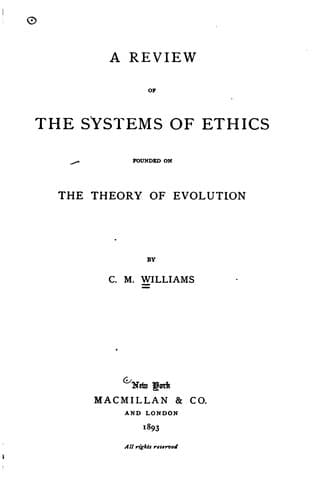
A Review of the Systems of Ethics Founded on the Theory of EvolutionWilliams, Cora May
Philosophy
A Review of the Systems of Ethics Founded on the Theory of Evolution
Williams, Cora May
Ethics, Evolutionary
But the sense of the word "freedom" with which the strife between
Determinism and Indeterminism has to do is that in accordance with
which a free will is not subject to the law of Causality, is not, like
other phenomena, a link in the chain of causes, but is, on the contrary,
a cause, without being an effect. To be free in will is, according to
this definition, to will without cause,--independent of all that has
gone before.
Indeterminism destroys the bond between the individual and his kind,
between the individual and the rest of existence. Indeterminism is hence
unable to regard existence as a totality. Every deeper philosophical or
religious conception becomes, thus, impossible; the only religious
conception consistent with Indeterminism is Polytheism, since every
being that can form the absolute beginning of a chain of causes is a
little god, an absolute being. This fact is to be noted, for the reason
that Determinism is sometimes designated as a godless doctrine.
The assertion that the will is without cause, and the assertion that we
ourselves are the cause of our willing, are two different assertions.
The last finds a cause in our nature. Thoughts and feelings, tendencies,
instincts, and impulses arise in us, and in these the origin of the acts
of the will is to be sought.
If the will, or a part of it, is not subject to the law of Causality, it
stands in relation to the whole personality as something isolated and
accidental. The Indeterminist who asserts that Determinism makes man a
mere machine, himself makes of him something much meaner, something
incoherent and accidental. Ethical judgment is based upon the assumption
that my action is mine; it is, therefore, clear and certain only when
motives and the decision they cause are known. The less my actions can
be understood by knowledge of my character, the more easily I may be
regarded as irresponsible. Although law regards, by its nature, action
and not motive, yet even the judge must gain an insight into the
motives, the outer and inner relations from which the deed originated,
both in order to determine the degree of punishment necessary, and in
order even to be fully persuaded that the action really took place.
Many recent Indeterminists designate the freedom of the will as
exceedingly small. They thus extend the dissolution of the unity of
existence and of the unity of personality to the act of willing itself.
Moreover, if responsibility depends upon freedom, it is impossible to
see how reward and punishment are to be justified upon this standpoint;
since the individual can say with reason that he is not guilty with
respect to the whole, but only with respect to a very small part of his
act.
Public-domain text, read in full here on John Shaqi.
Reviews
Reviews
No reviews yet
Be the first to share your thoughts on this work.
Elsewhere in the archive
Join the Discussion
Join the discussion
Sign in to leave a comment or review.
Sign InorCreate an account