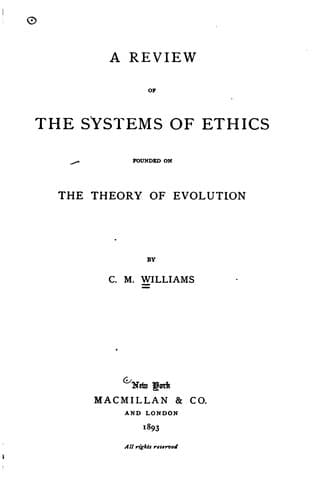
A Review of the Systems of Ethics Founded on the Theory of EvolutionWilliams, Cora May
Philosophy
A Review of the Systems of Ethics Founded on the Theory of Evolution
Williams, Cora May
Ethics, Evolutionary
The words Responsibility, Guilt, Accountability, are taken, like so many
other ethical expressions, from Jurisprudence, or rather they come to us
from a time when the distinction between the province of Jurisprudence
and that of Ethics had not yet been recognized. That I am made
accountable for my action means that I stand as the one to whom reward
or punishment for the deed is meted out. _For what reason_ the action is
rewarded or punished is a question by itself.
In relation to Ethics, the feeling of guilt, of responsibility or
accountability, signifies that my act is subjected to the judgment of
conscience. If I find discord between my act and that which I recognize
as good, remorse arises,--a feeling of inner disharmony, unworthiness,
and self-contempt which may increase until it becomes the greatest
psychical pain. This feeling may be defined, from a deterministic
standpoint, as dissatisfaction with oneself because one has not acted
otherwise, and the wish that one had done so. This wish arises in the
moment of reflection, when one weighs one's act. From the present wish
is not, however, to be concluded that one could just as well have acted
otherwise _at the moment the act took place_. Such an illusion dates the
experience dearly bought with mistake and remorse back to an earlier
period. According to the theory of retribution, remorse must be greatest
in him who has committed the greatest crime. This is not so, however;
since remorse arises from a contrast between ideal and act, which
contrast can take place only when the conception of the ideal is strong;
the purest and best characters often have the strongest feelings of
remorse.
Remorse first arises when a new attitude of mind is attained different
from that which ruled at the time of the action. Time is necessary for
this new feeling to replace the old, if it is to be more than a
momentary passion, and during this interval the two feelings are both
active in consciousness. This is the time of the birth-pains by which
the new character comes into being. The significance of remorse lies in
the fact that it urges forward, that it gives birth to impulse and
endeavor after a higher plane. Only because remorse is a _motive_, is it
of ethical nature.
Public-domain text, read in full here on John Shaqi.
Reviews
Reviews
No reviews yet
Be the first to share your thoughts on this work.
Elsewhere in the archive
Join the Discussion
Join the discussion
Sign in to leave a comment or review.
Sign InorCreate an account