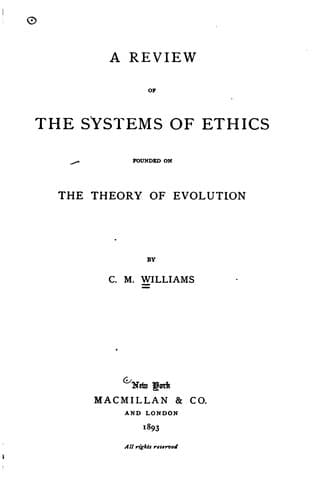
A Review of the Systems of Ethics Founded on the Theory of EvolutionWilliams, Cora May
Philosophy
A Review of the Systems of Ethics Founded on the Theory of Evolution
Williams, Cora May
Ethics, Evolutionary
If the law of Causality were not active in the realm of the psychical,
this ethical endeavor would be hopeless. Only where order reigns can
the will accomplish anything. Only as we know the law of outer nature,
and know what conditions must be produced in order to bring about a
certain result, can we serve our own ends in this province; and the like
is true in our relation to human nature. Here the problem is to find
motives of the right sort and of sufficient strength. Of what use were
all possible exertion if, under given conditions, the same motive were
followed by now this, now the other entirely different decision. I am
master of my future willing only in so far as a causal relation exists
between my present and my future will. We find, therefore, that the
reason why responsibility goes no further back in the causal chain than
the will, is this: that it is the will which is to be acted on and
altered. That which precedes the act of the will interests us,
ethically, only in so far as it influences the will.
It is a strange assertion, sometimes made, that the consistent
Determinist must be a mere spectator of his own and others' lives. As if
one could feel no pain or pleasure and no desire to interfere, because
one believes life to be subject to law. It is true that theoretical
study may weaken practical interest; but Indeterminism is a theory as
well as Determinism.
What the ethically bad is follows from what has already been said. It
consists of a more or less conscious isolation of the single moment in
the life of the individual, or of the single individual in the life of
the species, such that not only a hindrance to the welfare of individual
or species arises, but also a relaxation of energy and a diminution of
the coherence of individual or species. In most such cases, inertia is
at work. The one moment demands to be lived without any consideration of
others, the individual will not move outside the circle of his own
interests. Such a resistance to influence may be unconscious. It may be
authorized in so far as it is a condition of the development of real
willing that action shall not immediately respond to impression. In this
resistance lies, therefore, the germ of the ethical as well as the
non-ethical life of the will. The clearer consciousness becomes, the
more this inertia takes on the character of defiance. Or the discord
felt through consciousness of the good may be so painful that the
individual desires to free himself at any price. In this case, no
remorse is felt; on the contrary, the individual seeks to dull the
awakened consciousness, or to get rid of it.
Public-domain text, read in full here on John Shaqi.
Reviews
Reviews
No reviews yet
Be the first to share your thoughts on this work.
Elsewhere in the archive
Join the Discussion
Join the discussion
Sign in to leave a comment or review.
Sign InorCreate an account