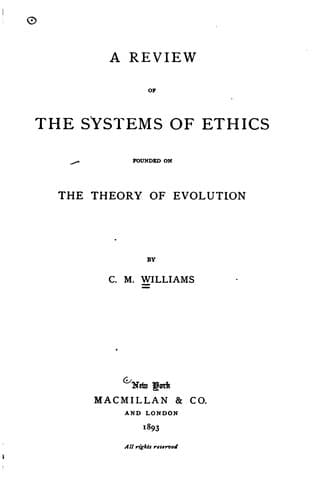
A Review of the Systems of Ethics Founded on the Theory of Evolution — John Shaqi
A Review of the Systems of Ethics Founded on the Theory of EvolutionWilliams, Cora May
Philosophy
A Review of the Systems of Ethics Founded on the Theory of Evolution
Williams, Cora May
Ethics, Evolutionary
almost any other bird with which they are associated." Moreover, there
are failures and imperfections in the nesting of birds that are not
compatible with the theory of instinct, which is supposed to be
infallible, but are quite so with the theory of intelligence and
imitation. Furthermore, in their manner of building, birds adapt
themselves to circumstances and frequently alter and improve. The theory
of instincts in man is likewise in the wrong. The sucking of the child,
which is said to be instinctive, is merely one of those _simple_ acts
dependent on organization, like breathing or muscular motion. "So
walking is evidently dependent on the arrangement of the bones and
joints, and the pleasurable exertion of the muscles, which lead to the
vertical posture becoming gradually the most agreeable one; and there
can be little doubt that an infant would learn of itself to walk, even
if suckled by a wild beast."
The theory of instinct "implies innate ideas[25] of a very definite
kind, and if established, would overthrow Mr. Mill's Sensationalism and
all the modern philosophy of experience."
The reason why natural selection acts so powerfully upon animals, is to
be found mainly in their individual isolation. "A slight injury, a
temporary illness, will often end in death, because it leaves the
individual powerless against its enemies.... There is, as a rule, no
mutual assistance between adults, which enables them to tide over a
period of sickness. Neither is there any division of labor; each must
fulfil _all_ the conditions of its existence, and therefore natural
selection keeps all up to a pretty uniform standard." But in man as we
now behold him, this is different. He is social and sympathetic; and in
society, a division of labor takes place that leaves the physically
defective still something to do by which he may sustain life, and saves
him from the extreme penalty which falls upon animals so defective. By
his skill in constructing for himself tools and clothing and in planting
his own food, man has an immense advantage over the animals, in whom a
change of structure must take place in adaptation to changed conditions.
Moreover, he not only escapes natural selection himself, but "is
actually able to take away some of that power from nature, which, before
his appearance, she universally exercised," establishing so his
supremacy by means of that subtle force we term mind. "We can anticipate
the time when the earth will produce only cultivated plants and domestic
animals, when man's selection shall have supplanted natural selection."
Public-domain text, read in full here on John Shaqi.
Reviews
Reviews
No reviews yet
Be the first to share your thoughts on this work.
Join the Discussion
Join the discussion
Sign in to leave a comment or review.
Sign InorCreate an account