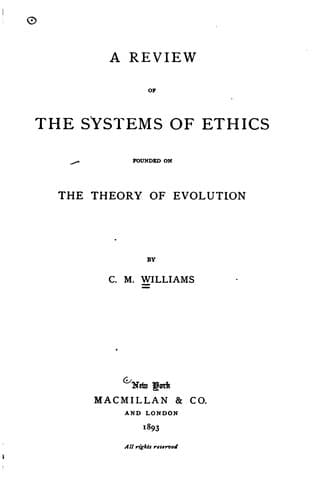
A Review of the Systems of Ethics Founded on the Theory of Evolution — John Shaqi
A Review of the Systems of Ethics Founded on the Theory of EvolutionWilliams, Cora May
Philosophy
A Review of the Systems of Ethics Founded on the Theory of Evolution
Williams, Cora May
Ethics, Evolutionary
We must, in future geological study, trace back the gradually decreasing
brain of former races to a time when the body as well begins materially
to differ, if we would wish to reach the starting-point of the human
family. Before that time man had not mind enough to preserve his body
from change. From this point, however, we shall probably see that, while
all other forms of animal life changed again and again, man's physical
character became fixed and almost immutable, advance taking place only
in his mental and moral characteristics, with which are united
modifications of the brain, as well as of the head and face, parts that
are immediately connected with the brain and the medium of the most
refined emotions. By man's superior sympathetic and moral feelings, he
becomes fitted for the social state. There is one feature, however, in
which natural selection will still act upon him--namely, the color of
the skin, which, as Mr. Darwin has shown, is correlated with
constitutional peculiarities, liability to certain diseases being often
accompanied by marked external characteristics; so that, in certain
countries, certain tints would be likely to be weeded out, and certain
other tints, with which, again, color and texture of the hair seem to be
associated, would be established by natural selection.
Natural selection has no power "to produce modifications which are in
any degree injurious to their possessor, and Mr. Darwin uses the strong
expression that a single case of this kind would be fatal to his theory.
If, therefore, we find in man any characters which all the evidence we
can obtain goes to show would have been actually injurious to him on
their first appearance, they could not possibly have been produced by
natural selection. Neither could any specially developed organ have been
so produced if it had been merely useless to its possessor, or if its
use were not proportionate to its degree of development. Such cases as
these would prove that some other law, or some other power, than natural
selection, had been at work. But if, further, we could see that these
very modifications, though hurtful or useless at the time when they
first appeared, became in the highest degree useful at a much later
period, and are essential to the full moral and intellectual development
of human nature, we should then infer the action of mind, foreseeing the
future and preparing for it, just as surely as we do when we see the
breeder set himself to work with the determination to produce a definite
improvement in some cultivated plant or domestic animal"; we should
infer a creation by law. Skull-measurement shows that the brain of the
savage was, and is, larger than it needs to be, and "capable, if
cultivated and developed, of performing work of a degree and kind far
beyond what he ever requires it to do." In evidence of this, Wallace
cites the measurements of Esquimaux skulls and the testimony of Paul
Public-domain text, read in full here on John Shaqi.
Reviews
Reviews
No reviews yet
Be the first to share your thoughts on this work.
Join the Discussion
Join the discussion
Sign in to leave a comment or review.
Sign InorCreate an account