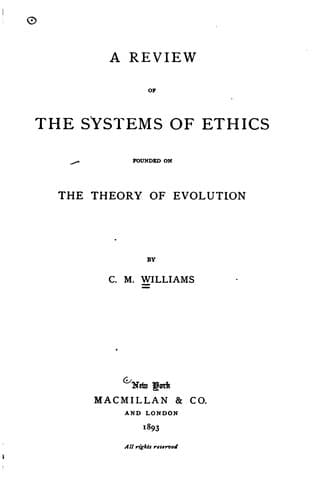
A Review of the Systems of Ethics Founded on the Theory of EvolutionWilliams, Cora May
Philosophy
A Review of the Systems of Ethics Founded on the Theory of Evolution
Williams, Cora May
Ethics, Evolutionary
The good is often defined as that which conduces to some end; but an end
is nothing other than something willed; that which conduces to an end is
the cause of something that is willed, so that this explanation also
refers back to a consciousness.
Whatever is existent for us must be existent in us, in our
consciousness. Our states of consciousness are either painful, or
indifferent, or pleasant. We must turn, therefore, in the last analysis,
not to things, but to the mind, if we wish to distinguish what is good
and what is bad; and according to the differing constitution of
different minds, the same things may be good or bad. There is good and
bad with respect to our body or senses, and good and bad with respect to
our mind. A moral good is one which causes conscious states of moral
satisfaction.
The good has often been divided into the useful and the agreeable. The
agreeable is that which causes immediate, the useful that which causes
mediate pleasure. A thing may be both useful and agreeable; and the like
is true of the disagreeable and the harmful. The useful and the harmful
in this, as it were inner, (subjective) sense, are to be distinguished
from the useful and the harmful in an objective sense; in the last
sense, that is useful which tends to the preservation of life. Between
the useful and harmful, and the pleasurable and painful, in this sense,
there must exist, as the theory of evolution teaches us, a wide-reaching
correspondence. Living beings do that which is pleasurable to them; they
avoid that which is painful; they continue alive when they do that which
is conducive to life and avoid that which is harmful to life. This
continuous process of exterminating those beings to whom the harmful is
agreeable and the useful painful, must tend to make the harmful coincide
with the painful, and the useful with the pleasurable. The agreement is,
however, far from being a perfect one; and it is the less so, the more
complicated are the conditions of life. It is the most imperfect in
human beings.
Good is that which causes pleasure or prevents pain; that is better
which causes more pleasure or prevents more pain. A thing may cause both
joy and pain; in this case, the excess decides whether a thing is good
or bad; and the greater the excess, the better or the worse is the
thing. The greatest possible excess of satisfied states of consciousness
in the life of a human being one may call his greatest possible
happiness. The greatest possible happiness is hence the standard by
which good and evil are determined.
From these reflections is to be seen that a distinction is to be made
between that which is _desired_ and that which is _desirable_. All that
is desired is pleasurable, yet much that is pleasurable has pain for its
result,--pain that is far greater than the momentary pleasure.
Public-domain text, read in full here on John Shaqi.
Reviews
Reviews
No reviews yet
Be the first to share your thoughts on this work.
Elsewhere in the archive
Join the Discussion
Join the discussion
Sign in to leave a comment or review.
Sign InorCreate an account