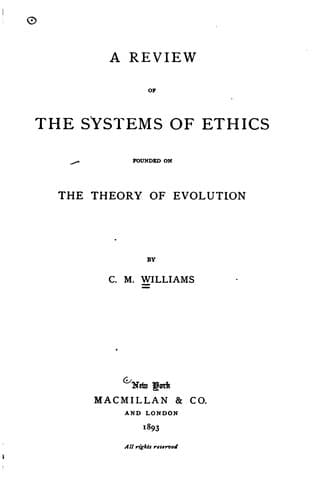
A Review of the Systems of Ethics Founded on the Theory of EvolutionWilliams, Cora May
Philosophy
A Review of the Systems of Ethics Founded on the Theory of Evolution
Williams, Cora May
Ethics, Evolutionary
The good is often considered as opposed to the agreeable, and the bad as
opposed to the disagreeable or painful. In this case, by pain and
pleasure are understood feelings of the moment, by good and bad are
understood enduring, or at least long-continuing causes of lasting or
oft-recurring pain or pleasure; momentary pleasure may be bought at the
expense of long suffering; and short pain may be the condition of the
prevention of greater evil.
A thing may be good as regards one individual, bad as regards another. A
thing is truly good as regards a society when its total effect has for
the society lasting beneficial results, that is, accords with the
happiness of the society during its whole existence; and that is for
mankind truly good which is, in its total effect, beneficial to present
and future humanity.
In general, we may say that, when we order our conduct by the thought to
serve mankind to the best of our ability, we have a satisfied
consciousness, a good conscience. In so far, therefore, a noble deed is
good for ourselves as well as for society. The question whether or not
the performance of our duty corresponds to our greatest possible
happiness, is a different one. But the good man does not allow this
thought the chief role in consciousness; he is filled with the thought
of doing his duty in devoting himself to the happiness of mankind, and
there is but _one_ form of his own happiness which he will not forego,
namely, the blessedness of a good conscience. This consciousness, this
blessedness which unites the human being to mankind, he should regard
as his highest good; for it is a moral good; and the dissatisfaction
which lies in the consciousness of having violated his duty towards
mankind he should regard as the greatest evil.
It may be objected that this morally satisfied consciousness, this sort
of joy, cannot be called a good. A good is the _cause_ of pleasurable
states of consciousness. But it would appear strange to claim that joy,
happiness, are not goods, and pain, unhappiness, not evils; the terms
"good" and "evil" and "worth" refer not only to joy and suffering, but
also to _desire_ and _will_; and no one doubts that happiness is an
object of desire, and pain an object of aversion.
From what has been said it appears that happiness cannot be defined as
"satisfaction of the desires." Such satisfaction may have unhappiness as
its result. Not all desires are to be satisfied simply because they are
desires.
Public-domain text, read in full here on John Shaqi.
Reviews
Reviews
No reviews yet
Be the first to share your thoughts on this work.
Elsewhere in the archive
Join the Discussion
Join the discussion
Sign in to leave a comment or review.
Sign InorCreate an account