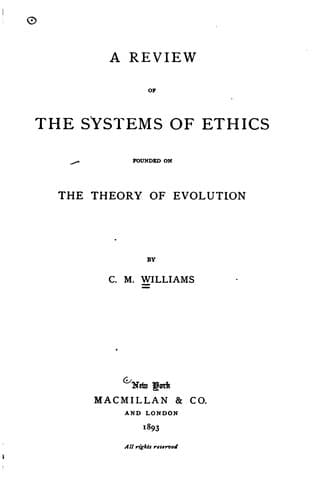
A Review of the Systems of Ethics Founded on the Theory of EvolutionWilliams, Cora May
Philosophy
A Review of the Systems of Ethics Founded on the Theory of Evolution
Williams, Cora May
Ethics, Evolutionary
The study of the history of moral conceptions appears to show us that
most changes in this province are the result of a change of views
concerning the effects of actions with regard to the welfare of society;
hence, that they were the fruit of experience. This process of change
takes place, however, very gradually; the rules which are the result of
experience are handed down, for the most part, without statement of
reasons; and only in a very limited measure do the new generations labor
for a progressive development of moral conceptions. We cannot wonder
that a clear consciousness of the highest reasons of moral precepts is
seldom to be found. Yet in civilized societies, the conviction is
general that at least an average conformity to rules of morality is the
indispensable condition of the safety and the good of society. The
answer to the question: What would happen if every one were to act thus?
has been regarded, from earliest times, as decisive with regard to the
moral quality of an act.
When we recognize that actions which we call good and bad are so called
because of their causal relation to pain and pleasure, the belief must
arise in us, that the worth of qualities of character depends on the
promise they contain of future action. The most important power for the
happiness or misery of humanity is the character of human beings. Hence
the morally good, excellence of character, is to be regarded as
preeminently Good. And so it appears that our instinctive judgments are
justified by the deliberations of calm reason.
The question: Why shall I act in accordance with the general welfare? is
answered by these considerations; because such action is right and
reasonable, enjoined by conscience and reason, by human nature itself in
its higher development. He who does not recognize this fact, who does
not find in it the highest and holiest of commandments, and who yet
desires to act reasonably and well, recognizing duties to all men, does
not see what he himself really will.
The conception of right-doing is the motive of the human being, in so
far as he is good. The teacher who desires to have moral influence will
endeavor to awaken this motive in his hearers or readers. For this
purpose he must appeal to their actual characters. And it is as much a
_petitio principii_ to assume, in Ethics, the existence of moral
feelings, as to assume, in Optics, the existence of sight. Just as there
are blind persons, so there are persons without moral feelings. These
are, however, comparatively few; some trace of moral feeling, of
conscience, is to be found in almost every member of society.
Public-domain text, read in full here on John Shaqi.
Reviews
Reviews
No reviews yet
Be the first to share your thoughts on this work.
Elsewhere in the archive
Join the Discussion
Join the discussion
Sign in to leave a comment or review.
Sign InorCreate an account