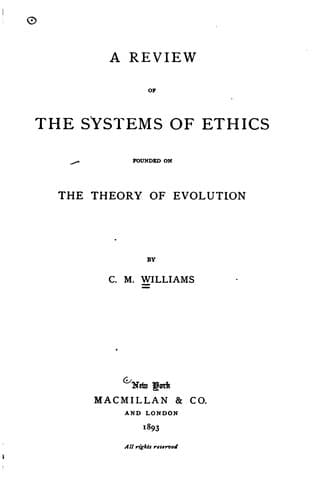
A Review of the Systems of Ethics Founded on the Theory of EvolutionWilliams, Cora May
Philosophy
A Review of the Systems of Ethics Founded on the Theory of Evolution
Williams, Cora May
Ethics, Evolutionary
The general welfare, that is, the greatest possible true happiness of
all, not the greatest happiness of the smallest number which is often
the ruling principle of state laws, nor the greatest happiness of the
greatest number without consideration of the minority,--is the highest
ethical criterion. It may be difficult to ascertain wherein this
happiness consists; Bentham demands, for the determination of the worth
of an action, a calculation of the intensity, duration, certainty,
fecundity, and purity, of the feelings produced by it. But the happiness
and misery of mankind is surely the most important object of mankind; it
must be, therefore, our highest care to ascertain the results of an
action _as far as we are able_. And, in fact, the most important results
of any form of action are generally ascertainable.
To make endeavor after one's own and others' perfection the criterion of
morality is to set up a false standard, a form without a content, since
"perfection" designates merely a state that accords with some
preconceived concept or end. The question is: What end shall human
perfection realize? The criterion of general welfare alone can define
human perfection. It is such a constitution of man's bodily and
spiritual characteristics as conduces in the highest degree to general
happiness.
Too long and detailed a consideration of possible results is not
desirable in every case where action is called for. There is seldom time
for a consideration of the intensity, duration, etc., of resulting pain
and pleasure. It is well, in most cases, to follow the general moral
rules we have attained to through previous reflection. In cases of
doubt, we need to appeal to our highest criterion. Often such doubt may
be caused by selfishness, by the hidden desire to act, after all, for
our own benefit; we need, therefore, to put to ourselves the question:
How would we judge the action of another in our own position? Thus we
arrive at the highest moral commandment, which is: So act that thy
conduct, if made general, would be for the good of mankind. And the
force of example is here one of the factors to be considered.
It has been asked what right one has to assert the rule that each one is
to count for one, and no one for more than one, in moral decisions. May
not one human being's capacity for happiness be greater than another's,
and his happiness, therefore, more to be considered? It may be answered
that bad men have never been embarrassed for an excuse for selfishness,
but that the arrogance of regarding one's own happiness as of greater
worth than that of others has brought incalculable harm into the world,
and that the only safe method of calculation for the purpose of
furthering the general welfare, is the rule above given,--that each one
shall count as one and no more.
Public-domain text, read in full here on John Shaqi.
Reviews
Reviews
No reviews yet
Be the first to share your thoughts on this work.
Elsewhere in the archive
Join the Discussion
Join the discussion
Sign in to leave a comment or review.
Sign InorCreate an account