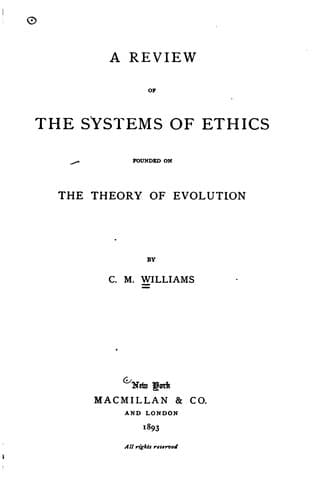
A Review of the Systems of Ethics Founded on the Theory of EvolutionWilliams, Cora May
Philosophy
A Review of the Systems of Ethics Founded on the Theory of Evolution
Williams, Cora May
Ethics, Evolutionary
The rule that the greatest possible happiness of _all_ is to be striven
for, is an assertion that the happiness of every one is to be
considered, that not that of the lowest human being is to be interfered
with unless such interference is _necessary_ in order to prevent still
greater harm to others; and that no such interference shall be greater
than is positively necessary in accordance with this aim. The highest
moral law is thus nothing more than the Christian commandment of love to
all men. And the rule "To count each as one, no more," may receive the
restrictive clause "in so far as the good of the whole of society is not
diminished by so doing."
Some Darwinians are inclined to regard the preservation of existence as
the criterion by which to judge the moral quality of action. "Aim for
the preservation of the species" would be, from their standpoint, the
moral law. But mere existence is not happiness; that is shown by the
fact of suicide. However, it is true that health is one of the
conditions of happiness. Pessimists are generally men of an unhappy
temperament, often of morbid physical constitution; medical science
must, in its progress, help to prevent the development of such morose
dispositions. Want of love may also be a cause of pessimism; most
pessimists have been lonely men. And want of employment may also lead to
pessimism. If we follow Rousseau's advice not to listen to those who are
in exceptional abnormal positions, but appeal to those who constitute
the great majority, we shall conclude that, in general, the happiness of
men greatly exceeds their misery. The increase of suicide is often used
as an argument that civilization has not caused an increase, but a
decrease, of happiness. To this argument it may be answered that the
religious scruples which formerly withheld men from this extreme step
have diminished, that men have grown more self-conscious and independent
in action; and that, moreover, our age is one of unrest, a
transition-period such as no other period has been. When we examine the
lives of tribes on a low plane of civilization, we find their existence
full of uncertainty and of superstitious fear, and at the mercy of the
forces of nature. Without doubt, much misery exists; a great part of it,
however, is caused by the disappointment of too extreme demands for
happiness; the individual must not require that life shall be continuous
rapture.
The recognition of what right action is, is not its accomplishment. Pain
and pleasure determine the will,--the pain and pleasure of the person
who wills, since he cannot feel with the feelings of others or will with
their will any more than he can move with their limbs. He may have a
conception of the welfare or suffering of others, but a mere mental
image does not determine the will. Only when such a conception arouses
pleasure or pain in the subject himself, are will and action possible.
Public-domain text, read in full here on John Shaqi.
Reviews
Reviews
No reviews yet
Be the first to share your thoughts on this work.
Elsewhere in the archive
Join the Discussion
Join the discussion
Sign in to leave a comment or review.
Sign InorCreate an account