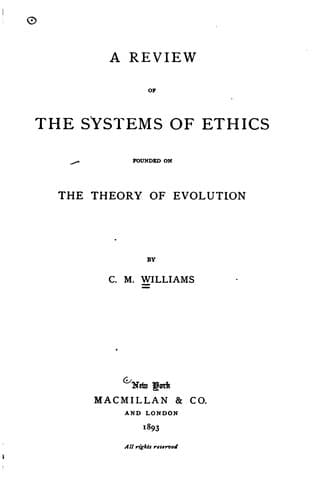
A Review of the Systems of Ethics Founded on the Theory of EvolutionWilliams, Cora May
Philosophy
A Review of the Systems of Ethics Founded on the Theory of Evolution
Williams, Cora May
Ethics, Evolutionary
In the judgment of an action, two questions must be distinguished: the
question whether the action is right or wrong, and the question as to
what inference shall be drawn from it with regard to the character of
the performer.
In the action, there must be distinguished the following points: the
movement of the body; the results of the act; the act of the will; the
intent; the presence or absence of a conviction that the action will not
have evil results; the part of the intent willed, not merely as means
but as end; and the incentive, or feeling from which the action springs.
The chief end and the incentive together are often called the motive.
The movement of the body is not an object of moral judgment, as are not,
also, the outer results of the action as such. Nor is a mere act of the
will as such, but its nature, of moral importance.
No human motive or incentive is, in itself, bad. Not even anger and
hatred are in themselves evil; since wrath against wrong is justifiable.
Yet motives are by no means morally of the same worth; while where
motives directed to the good of the individual are at work, the action
will be, in nine cases out of ten, in accordance with the general good;
it will be, let us say, in nine cases out of ten, contrary to the
general good where motives of malevolence are active. And for this
reason the motive in the single case gives us a clue to the character.
There exists a certain stability of character which makes it likely that
the individual who acts out of good motives on one occasion will do so
again. Of greatest worth are the motives which spring from desire for
the general good; these are moral motives. Actions may be right, yet
immoral, and moral yet wrong. Yet the theory that the objective judgment
of an action, and the judgment of the character of the doer have nothing
in common is erroneous; for in both cases the highest ground of
reasonable judgment is the same; namely, the general good.
Blame is not merely for the sake of prevention through fear; since we
may blame a deed and not its doer. When a man does what we consider
wrong under the impression that he is acting for the general good, we do
not endeavor to frighten him from his conduct by blame, but to convince
him of his error.
But the significance of the motives of an action does not lie merely in
our inference from them to the character of the doer; from the actual,
or inferred, motives of the action spring its most important results;
namely, its influence upon the morality of human beings. Every moral
action reacts for good upon the performer, strengthening his tendency to
such conduct; and it is, besides, an inciting example.
It is not necessary for morality that all actions should take place
directly from desire for the general good, but only that the belief be
present that they are in harmony with the general good; duty need not be
the only motive, but simply the ruling one; one may act immediately from
other motives.
Public-domain text, read in full here on John Shaqi.
Reviews
Reviews
No reviews yet
Be the first to share your thoughts on this work.
Elsewhere in the archive
Join the Discussion
Join the discussion
Sign in to leave a comment or review.
Sign InorCreate an account