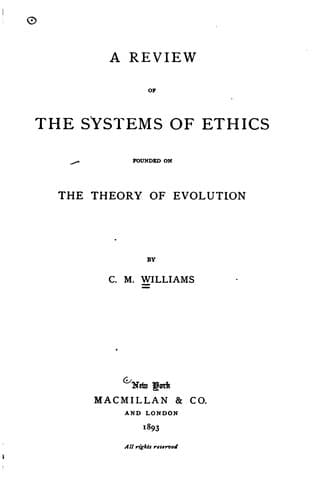
A Review of the Systems of Ethics Founded on the Theory of EvolutionWilliams, Cora May
Philosophy
A Review of the Systems of Ethics Founded on the Theory of Evolution
Williams, Cora May
Ethics, Evolutionary
The aesthetic judgment of a character is to be distinguished from the
moral judgment of it. Much that pleases one aesthetically in character is
morally indifferent; and much that is morally of the greatest worth has
little or no aesthetic value. The talk of an identity of the beautiful
and the good has caused much confusion.
Things have particular qualities according to which they affect us and
are affected. All that I can predicate of things, all their being is
their effect. And when I say that a certain thing, as long as it does
not change, will, under the same circumstances, operate in the same way,
I assert merely that this certain thing, as long as it remains
unchanged, is this certain thing. It may often be difficult or
impossible to determine whether or not the thing has changed, but if it
has not changed, it must, under the same circumstances, operate in the
same manner as formerly. As everything is, at each moment, a definite
thing, so is also every human being; he has definite qualities, and if
these do not change, neither does his action under the same
circumstances; if it could change, he would act according to that which
he is not.
Different individuals have different innate tendencies; and differing
circumstances develop similar tendencies in different ways. The history
of the human being is his character, if we add what he has inherited to
his own history. To reflect upon human nature is to assume its
conformity to law; to deny such conformity involves ceasing from thought
on it; for thought means the conclusion of like from like. Though the
action of the human being depends, in a high degree, upon circumstances,
we can often predict, from a knowledge of his character, the general
nature of his action. And if our expectation should be, for once,
disappointed, we do not say that his character has suddenly passed into
its opposite, but that we had an insufficient knowledge of the
circumstances, or that we imputed to him a character which he did not
really possess. We have thus to distinguish two groups of facts in the
contemplation of a particular action: the present constitution of the
doer of the action, and that of the outward circumstances concerned; if
a change occurs in either, the conduct will also change. Criminal
statistics are evidence of the effects of similar circumstances upon
similar characters.
Public-domain text, read in full here on John Shaqi.
Reviews
Reviews
No reviews yet
Be the first to share your thoughts on this work.
Elsewhere in the archive
Join the Discussion
Join the discussion
Sign in to leave a comment or review.
Sign InorCreate an account