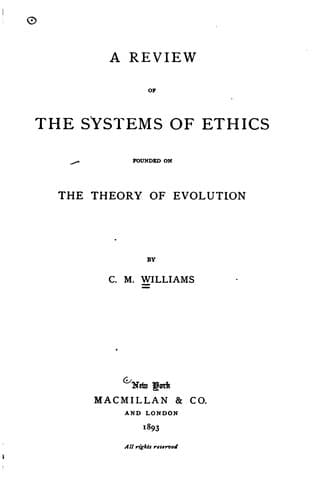
A Review of the Systems of Ethics Founded on the Theory of Evolution — John Shaqi
A Review of the Systems of Ethics Founded on the Theory of EvolutionWilliams, Cora May
Philosophy
A Review of the Systems of Ethics Founded on the Theory of Evolution
Williams, Cora May
Ethics, Evolutionary
Broca to the fine form and capacity of the skulls of Les Eyzies, a race
of cave-dwellers undoubtedly contemporary with the reindeer in Southern
France.[26] He also argues that the loss, by man, of the hairy covering
so long persistent in the mammalia, cannot have taken place on account
of its lack of usefulness, since even the most savage tribes show a need
of it, endeavoring to replace it by artificial coverings, especially on
the back. This naked skin is, however, of importance to civilization,
since it leads to the adoption of both clothing and houses, and
develops, through the former, the sense of modesty. The loss of the
prehensile character of the whole foot, and especially of the pedal
thumb, is a preparation for civilization. So, too, the capacity of the
human voice for music, of little use to savages, since their singing
consists only in a sort of monotonous howling, must be regarded as a
preparation for the civilized man's delight in music, and probably also
for a higher state than that to which we have yet attained.
Nor can the sanctity which attaches to virtue, even among savages, be
explained by utility or natural selection. The "mystic sense of wrong,"
which, although few laws enforce truth, yet attaches to untruth, even
among whole tribes of utter savages, is an example of such sanctity.
Wallace adds, however, in the same breath: "No very severe reprobation
follows untruth. In all ages, falsehood has been thought venial or even
laudable under certain conditions." He asserts that "the utilitarian
doctrine is not sufficient to account for the development of the moral
sense," but seems, nevertheless, to adopt a utilitarian principle as the
basis of the moral sense when he says: "Where free play is allowed to
the relations between man and man, this feeling [_i.e._ of sanctity]
attaches itself to those acts of universal utility or self-sacrifice
which are the products of our affections and sympathies which we term
moral"; and he adds: "while it may be, and often is, perverted to give
the same sanction to acts of narrow and conventional utility which are
really immoral,--as when the Hindoo will tell a lie, but will sooner
starve than eat unclean food; and looks upon the marriage of adult
females as gross immorality." The explanation of this inconsistency is,
according to Wallace, that the strength of the moral feeling, in any
case, will depend on the individual or racial constitution, and on
education and habit; and the acts to which its sanctions are applied
will depend on the extent of modification of the simple feelings and
affections by custom, law, and religion. If a moral sense is an
essential part of our nature, it is easy to see that its sanction may
often be given to acts which are useless or immoral, just as the natural
appetite for drink is perverted by the drunkard into the means of his
destruction.
Public-domain text, read in full here on John Shaqi.
Reviews
Reviews
No reviews yet
Be the first to share your thoughts on this work.
Join the Discussion
Join the discussion
Sign in to leave a comment or review.
Sign InorCreate an account