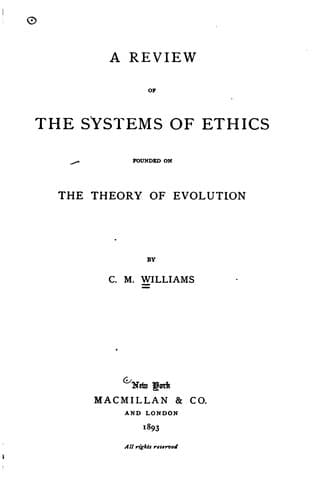
A Review of the Systems of Ethics Founded on the Theory of EvolutionWilliams, Cora May
Philosophy
A Review of the Systems of Ethics Founded on the Theory of Evolution
Williams, Cora May
Ethics, Evolutionary
If we are able to love the good in God, we may also learn to love the
good in those about us, and be incited, by it, to emulation. The love of
the good in men has always had stronger effect than love for a distant
God of whom but little was known. It was the thought of the man Buddha
which exerted an ennobling influence upon thousands, and it was the
thought of another human being that moved the "christians" more strongly
than did that of a Father in Heaven. Do we love father and mother,
brother or sister, wife or child, or our friends, for God's sake? Why
may we not love all men, as we love our friends and children, for their
own sake?
It has been said that there is no accountability, if not to God. But if
God is the author of the world, he must himself be the cause of evil,
either by direct influence or by neglect to avert. Where, then, is the
justice of his punishment? It does not suffice to answer that God's
justice is not our justice; for in that case, what right have we to
apply the word to him at all?
History demonstrates the fact that morality is by no means necessarily
connected with religion. In the name of religion millions upon millions
of human beings, and these often the most upright and conscientious men
of their nation, have been put to death, and thus the civilization of
whole peoples has been retarded. Slavery in America had no stronger
friends than the churches. How is the forgiveness of sins by God to be
justified? Are the evils which they caused any the less existent because
of such forgiveness, and is it well for the doer to escape, in this way,
the sense of responsibility? Only labor for the good of humanity is the
way of atonement. We ourselves are the creators of the kingdom of
righteousness.
Many claim that Ethics is not indeed based upon Theology, but that it
needs a metaphysical, a teleological, foundation. For it presupposes
that human life has an "end." If we wish to ascertain how our life
should be conducted, we must ascertain what is the end Nature has in
view for us.
Public-domain text, read in full here on John Shaqi.
Reviews
Reviews
No reviews yet
Be the first to share your thoughts on this work.
Elsewhere in the archive
Join the Discussion
Join the discussion
Sign in to leave a comment or review.
Sign InorCreate an account