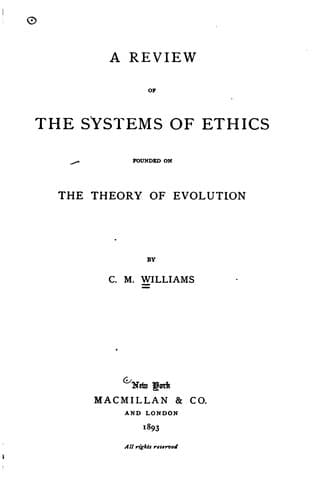
A Review of the Systems of Ethics Founded on the Theory of EvolutionWilliams, Cora May
Philosophy
A Review of the Systems of Ethics Founded on the Theory of Evolution
Williams, Cora May
Ethics, Evolutionary
But an end is an effect imagined beforehand and willed, which we cannot
bring about immediately but only through a chain of causes. These causes
we call the means to the end. They too are willed, but only indirectly
and because the end is attainable only through them. These processes to
an end are sometimes treated as if the causal succession in them were
reversed, so that the last effect appears as the beginning, and the
future determines the present; in this sense, the end has been called
the end-cause, because the final link of the process causes the
beginning. But this is a senseless conception, since the future, that
which does not yet exist, cannot now operate. In fact, the succession of
causes and effects is no more broken into in the processes leading to an
end than in any other processes. When a human being imagines to himself
a result and endeavors to bring it about, these mental processes are not
future but present; and they are not determined by an influence of the
future upon the present, but by an influence of the past upon the
present; they follow from experience, that is, from that which has
already occurred. They are causal processes in which the activities of
understanding and will have part. Hence "ends" exist in nature in so far
as they exist in man and the higher animals; but outside these, ends
cannot be predicated, unless Nature is regarded either as gifted with
imagination and will or as the creation of a being possessing these. But
imagination and will require, according to all our experience, a highly
developed nervous system, and to assume their existence where such a
centralized system does not exist is scientifically injustifiable.
Moreover, the laws of thought by no means determine us to inquire after
a cause of the whole world, since the concept of cause is applicable
only to changes, not, however, to enduring existences and their
qualities.
Or let us assume that we had discovered an end set by Nature. Then,
either it would appear useless to interfere with its attainment and
unnecessary to assist in it, or it would appear to us possible to oppose
this end. In this latter case, cause must be shown why we should assist,
or should resist, the process of Nature.
Many philosophers have said that man should live according to his own
nature. If the word "nature" here denotes the totality of his
characteristics, it is evident that the worst actions are not less
natural than the best. Therefore, the word nature cannot, as here used,
have this sense; the natural in this sense is not identical with the
moral. Nor can the term as here used refer to the usual, for in that
case the greatest moral excellence, as unusual, must be rejected. Nor
can it be used to designate the more primary, for in that case, again,
the later developments of benevolence and truthfulness should be
rejected.
Public-domain text, read in full here on John Shaqi.
Reviews
Reviews
No reviews yet
Be the first to share your thoughts on this work.
Elsewhere in the archive
Join the Discussion
Join the discussion
Sign in to leave a comment or review.
Sign InorCreate an account