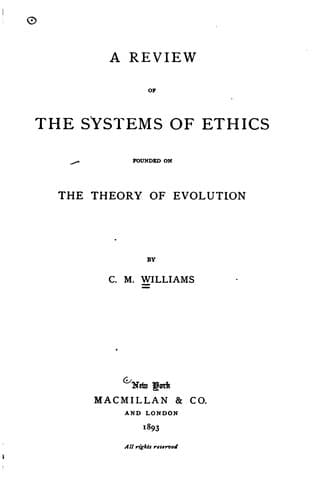
A Review of the Systems of Ethics Founded on the Theory of EvolutionWilliams, Cora May
Philosophy
A Review of the Systems of Ethics Founded on the Theory of Evolution
Williams, Cora May
Ethics, Evolutionary
The word can have but one other sense, namely, as opposed to artificial.
But what is in man artificial and what is natural? It seems that the
natural is understood as that which is not the work of human intention
and reflection, of labor, and of education. Innate impulses would be,
according to this definition, natural. But it is evident that one cannot
abandon himself to his blind impulses; society could not exist under
such circumstances.
Or if it be said that, since all organs and impulses of the human being
tend to preservation of the species, and that this must, therefore, be
the end, then let us say "the preservation of the species," or "the good
of mankind" but not "the natural life," is the end for man to attempt.
Nature as a whole is neither good nor bad. Her cruelty in the struggle
for life is continuous. Yet this is not "cruelty," in so far as it is
not willed. She has often selected the best men for her sacrifices. Yet
this is not all that is to be said of the relation of Darwinism to
Ethics. The law of natural selection regulates not only the life of the
individual but also that of peoples and nations. Evil may arise and
prosper in society. But it has no permanent existence. The chances that
the descendants of human beings possessing evil characteristics will
long survive, that they will not, sooner or later, perish as the result
of conflict with the mandates of health, or the laws of the state, or
the demands of society, are not great. In the life of nations, it
appears more clearly than in the life of the individual, that "Death is
the price of sin." Should in any society the opinion gain power that the
struggle for existence authorizes or demands a regardless pursuit of
one's own interests, an oppression and robbery of the weak by the
strong, an annihilation of pain through the annihilation of the
suffering individuals, an outrooting of conscience, and the natural
voice of pity which raises protest against such a course; should
selfishness be bred, and physical strength and refined cunning become
the highest ideal; such a community would be on the verge of its own
destruction; it would have labored for this result by justifying the
struggle of all against all, permitting this the moment that a conflict
of interests arose. Let times of need and danger, times of national war,
come, and we shall see what is the fate of a society in which love of
country, self-sacrifice, a sense of the ideal, respect for truth and
justice, are only subjects for scorn. "The world's history is its
judgment-day."
All positive human authorities are subject to the authority of the
conditions of life. If they do not take note of the nature of things, if
they disturb the foundations of social life, their endeavors must
finally suffer shipwreck on the rock of this powerful impersonal
authority.
Public-domain text, read in full here on John Shaqi.
Reviews
Reviews
No reviews yet
Be the first to share your thoughts on this work.
Elsewhere in the archive
Join the Discussion
Join the discussion
Sign in to leave a comment or review.
Sign InorCreate an account