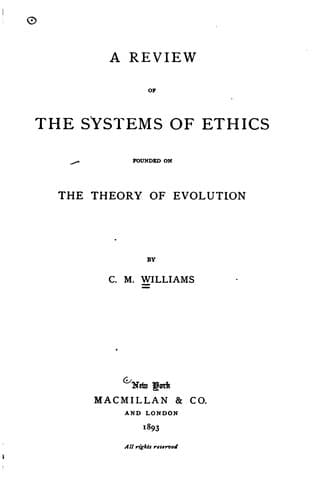
A Review of the Systems of Ethics Founded on the Theory of EvolutionWilliams, Cora May
Philosophy
A Review of the Systems of Ethics Founded on the Theory of Evolution
Williams, Cora May
Ethics, Evolutionary
This account of good character uses ideas which apply, _mutatis
mutandis_, to the life of any organism, as well as to the mind of man;
it merely explains, in terms of human experience, the elements involved
in the conception of organization; the difference lies simply in the
nature of the elements involved in the adjustment, the elements being,
in the case before us, conscious acts. To the question whether such a
definition of morality would not apply rather to conduct than to
character, and whether, the volitions being conceived as a series in
time, it does not dissolve the unity of character, may be answered that
conduct and character have already been shown to be identical, and that
unity can no more be denied to the series of acts involved than it can
be denied to the growing plant or animal whose functions are successive.
The unity conditioned by time is a unity characterized by succession, as
that of space by extension. The objection, as it gathers its strength
from a persuasion that the good character should be described by the
feelings or sentiments of any one time, is legitimate; good conduct is
built upon a man's needs or desires and is defined as satisfying every
part of his nature in its proportion; so that an equilibrium of the
emotions and the moral sentiments is involved in morality, and any
sentiment is moral which can be equilibrated with the rest. "The good
man may be described either as an equilibrated order of conduct, or as
an equilibrium of moral sentiments or of the parts of his nature.
Nevertheless, the order of conduct is a prior conception to that of
structural equilibrium." In a machine, the combination of parts is made
in order to produce the motion of the engine, and the equilibrium is
maintained by the motion. "In the organism, the bodily structure retains
its proportion only in so far as it is in physiological action, and this
physiological action subserves the conduct of the organism," while "in
like manner the equilibrium of moral sentiments exists only through
conduct and is determined by the requirements of conduct." The
equilibrium is effected simultaneously both for conduct and the moral
structure. The ideal is a plan of conduct, ideal in that it is never
fully attained. The ideal is hypothetical in two senses. It supposes
that every member of the order is good, whereas no life contains good
acts only; and that the order itself remains permanent, whereas morality
is necessarily progressive. Nevertheless, it is to be observed that the
ideal is a realized ideal. It is realized in every good act, since the
good act is the act which has the shape it would wear in the ideal
order. "Though it is adjusted to imaginary elements, it realizes the
whole so far as its own particular share is concerned."
Public-domain text, read in full here on John Shaqi.
Reviews
Reviews
No reviews yet
Be the first to share your thoughts on this work.
Elsewhere in the archive
Join the Discussion
Join the discussion
Sign in to leave a comment or review.
Sign InorCreate an account