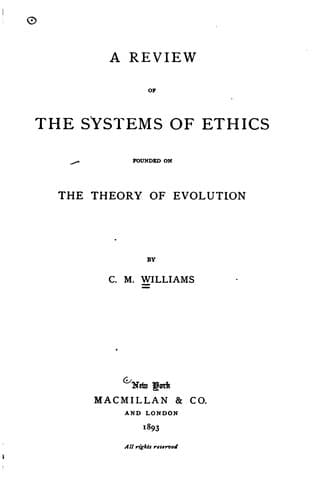
A Review of the Systems of Ethics Founded on the Theory of EvolutionWilliams, Cora May
Philosophy
A Review of the Systems of Ethics Founded on the Theory of Evolution
Williams, Cora May
Ethics, Evolutionary
Morality implies the existence of society. It is useless to inquire what
would be moral in case the human individual were an isolated being; the
fact is that he is not so, and that all moral judgment implies not only
the judgment of other individuals besides the acting individual, but
also the function of the acting individual as a member of a society. Yet
each member of a society has his special individual work, so that duty
varies according to individual circumstances, and so far from its being
true that morality is not a respecter of persons, it is a fact that it
is always a respecter of persons. This does not deny that there are
certain common bounds of morality, which allow the formation of some
general propositions; nor does it mean that each individual is at
liberty to construct his own moral precepts. The individuality of
morality, which finds a place or vocation for each individual, involves
an equilibrium between the members of society, in which consists the
morality of the whole.
The so-called self-regarding virtues are social as well as
self-regarding; their disregard involves evil, not to the individual
alone, but to others also. It may be objected that acts and thoughts
which can never be known to others are condemned by conscience. In
answer it must be observed:--
(1) That the knowledge of others is a matter of degree; my friends know
my actions; and in order to judge an action, it is not necessary to
suppose the whole nation looking on.
(2) That as personal morality becomes more and more complex, and hence
knowledge by others less and less possible, we leave the judgment of an
act more to the conscience of the individual, as vicegerent of the moral
law. "Acts which are wrong when nobody knows them have come to be so by
a process beginning with simple acts which are known, that is, known in
their outward appearance." The act, known or unknown, leaves its impress
upon character, raising or lowering the efficiency of the agent; and
hence is judged good or bad. The study of art and science has, thus,
moral value, as influencing character.
Good and bad acts and conduct are thus to be distinguished by their
adjustment or non-adjustment to the social order. The adjustment takes
place in a similar manner as in a trial of strength, and the compromise
between the different individuals must be taken as measuring the actual
forces which were engaged.
The social organism has both its morphological, or structural, and its
physiological or functional aspect; and here, once more, the order of
functions is a prior conception to the structural order; in the society,
conduct bears to structure the relation which physiological action in
the body bears to the bodily structure. The social ideal is doubly
hypothetical, implying that all members of the society are good and that
society is statical.
Public-domain text, read in full here on John Shaqi.
Reviews
Reviews
No reviews yet
Be the first to share your thoughts on this work.
Elsewhere in the archive
Join the Discussion
Join the discussion
Sign in to leave a comment or review.
Sign InorCreate an account