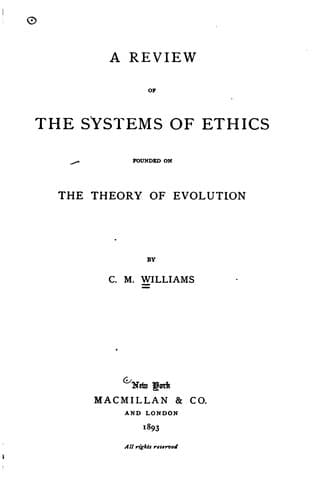
A Review of the Systems of Ethics Founded on the Theory of EvolutionWilliams, Cora May
Philosophy
A Review of the Systems of Ethics Founded on the Theory of Evolution
Williams, Cora May
Ethics, Evolutionary
That to which moral judgment applies with regard to the individual's
relation to society, is the adjustment of individual wills regarded
either as directly appearing or as latent and capable of acting, the
occasion being given. The moral principle in society as a whole is thus,
as in the case of the individual, a rational one, and Aristotle rightly
gives the same name ([Greek: orthos logos]) to it as to the principle of
individual action. The moral individual is the reproduction in small of
the social order. But "the two conditions that the individual must be a
harmony within himself, and that he must possess all the powers that are
required of him for the purposes of society, are not different, but
identical." For the absence of such powers implies the absence of
adjustment to his conditions, failing which adjustment the inner harmony
is impossible, although life may be continued, just as it may be
continued under diseased physical conditions.
Good men may thus be said to conform to a certain type or ideal; but
this type is not merely something to which they are fashioned, but to
which they themselves are the contributory elements. Hence the social
ideal is a species of which all good men are the individual instances;
and the species exists, not, as in the case of natural science, as a
generalization in the mind of the observer or as an identical plan upon
which the members are organized, not as a mere collection of
individuals, but as in itself an organism. "Let it not be objected that,
since no society is in perfect equilibrium, and the ideal exists only in
good men, the ideal is therefore as much a creation of the observer's
mind as a natural species. An ideal implies no contrast of observer and
observed: conduct is something mental: the ideal is a reality of mind,
existing in the minds of those who act upon it. The social ideal has
thus a concrete existence in the collective action of good men."
In this manner, the supposed independence of the tendencies towards
Individualism and Universalism disappears, the harmony of the individual
and his harmony with society being identical--a true independence being
equivalent to true cooeperation.
Morality implying adjustment to the ideal order, a realization of the
bearings of our acts is important. But we need no special moral faculty
to teach us morality; it is prompted by thoughts and feelings that, as
the result of a process of compromise, are thoughts and feelings
adjusted to a social order.
Public-domain text, read in full here on John Shaqi.
Reviews
Reviews
No reviews yet
Be the first to share your thoughts on this work.
Elsewhere in the archive
Join the Discussion
Join the discussion
Sign in to leave a comment or review.
Sign InorCreate an account