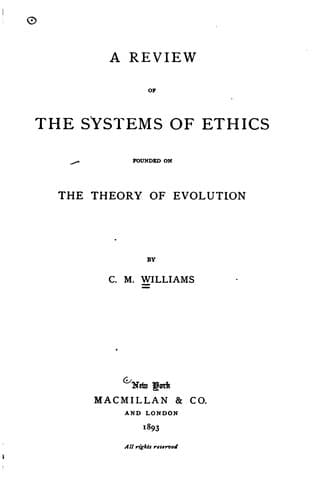
A Review of the Systems of Ethics Founded on the Theory of EvolutionWilliams, Cora May
Philosophy
A Review of the Systems of Ethics Founded on the Theory of Evolution
Williams, Cora May
Ethics, Evolutionary
Obligation "expresses that an act is the act required." "It is that
relation in which the single part of the order stands to the whole
order, when it is confronted by the whole," whether we consider the
single act in relation to the whole character of the individual, or the
single individual in his relations to society. "Duty in the abstract is
the name which comprehends obligation in all its details; a duty in the
concrete is any good act regarded in its relation to the whole. On the
other hand, the whole has _authority_ against its parts, and every
particular duty is said to have authority just so far as it is backed by
the whole mass of duties," as the command of a sovereign has authority
because it gives expression to the will of the whole society over which
he presides. Obligation "corresponds to the necessity under which an
organism lies of acting in a certain manner in order to conform to its
type." Duty is thus not necessarily antagonistic to inclination, as
Kant conceived it, since, in the good man, inclinations are adjusted to
the requirements of social life; and obligation is thus different from
compulsion, which, as attendant on authority, applies to the bad, not
the good, man. The negative side of compulsion is responsibility, which
implies that, in the case of transgression, the person will be called to
account. Duty, though thus free from the idea of antagonism, is itself
always negative, implying subjection of the individual to the larger
order. It is from this negativity that duty lends itself to the legal
idea of compulsion, and in general wears a legal garb.
In law, rights and duties are correlative, the right of one implying
duties of others, and _vice versa_; but in morals, rights and duties are
not merely correlative but identical; it is a duty to insist on rights
in so far as these rights are moral, not merely legal, and the
individual has a right to the performance of duty.
The moral judgment is a judgment on a fact, but expresses, nevertheless,
a fact also; it expresses an adjustment to an ideal order, which, if
ideal, is yet a fact, although never realized in its entirety. Thus
morality is not a mere matter of opinion. Opinions may differ with
regard to a fact of morality as different individuals differ in the
apprehension of a physical fact. An action is not right simply because I
think it is so; but the opinion of the good man represents what is
really good.
Public-domain text, read in full here on John Shaqi.
Reviews
Reviews
No reviews yet
Be the first to share your thoughts on this work.
Elsewhere in the archive
Join the Discussion
Join the discussion
Sign in to leave a comment or review.
Sign InorCreate an account