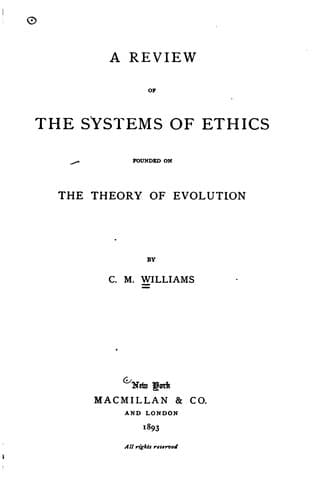
A Review of the Systems of Ethics Founded on the Theory of EvolutionWilliams, Cora May
Philosophy
A Review of the Systems of Ethics Founded on the Theory of Evolution
Williams, Cora May
Ethics, Evolutionary
Goodness is a mental fact; the apprehension of goodness, as the passing
of judgment upon it, is different from it; but it is nevertheless, in
another sense, the goodness of the good man which approves or is the
approbation of the good act; and "badness exists in the mind of the good
man and is known as disapprobation." The quality of an action is that
which excites approbation; its goodness or adjustment is nothing but the
approbation of the good man, but not of other men. In like manner, duty
and the sense of duty are the same thing. When the act judged is
presented to the mind only as idea, the feeling of approbation or
disapprobation is that which we know as the working of the moral sense
or conscience.
It is this truth that goodness and approbation are identical that
Intuitionism builds upon. Intuitionism, however, regards goodness as
some new quality of action, peculiar and inexplicable; while a true
analysis looks upon goodness as no new quality, the moral judgment
merely placing a mark upon any action as conforming to a certain order
or equilibrated system wanted.
There is in the good man a vague mass of moral sentiments and emotions;
and when the idea of any act comes in contact with these, a feeling of
satisfaction or dissatisfaction arises, according as the idea fuses with
this mass of sentiments or fails in adjustment to them. Moral promptings
are merely promptings which have been adjusted on one side and the other
until they have come to be in harmony with social conditions; they grow
out of the natural feelings by the process of adjustment. The word
"conscience," as it is more generally used, seems to emphasize the
element of reflection in a greater degree than "moral sense." The
explanation of the apparent independence of conscience is merely that,
in the good man, the moral order is realized, and action from moral
principle takes place spontaneously. In so far as this is true, he is,
in the ethical sense, free, yet not free in the sense that he is to be
bound by his own conscience alone in opposition to the judgment of all
other consciences; "on the contrary, the conscience sits as a tribunal
on a man's acts or intentions, just because it is the representative of
the moral order."
In speaking of a "perverted conscience," morality condemns the isolation
of a man's ideas about right conduct, from the judgment of his fellows.
The conscience, by reason of the element of reflectiveness, is higher
than the moral sense; and the cultivation of a refined conscience is the
basis of all morality. Yet this very reflectiveness involves danger, in
that, attaching itself as it does to the negative side of duty, it tends
to associate the latter with the idea of painfulness rather than of
pleasure, and to induce fear, and also in that it tends to develop a
morbid subjectivity of feeling through too much self-examination.
Public-domain text, read in full here on John Shaqi.
Reviews
Reviews
No reviews yet
Be the first to share your thoughts on this work.
Elsewhere in the archive
Join the Discussion
Join the discussion
Sign in to leave a comment or review.
Sign InorCreate an account