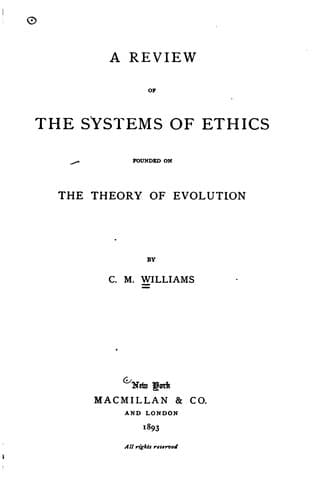
A Review of the Systems of Ethics Founded on the Theory of EvolutionWilliams, Cora May
Philosophy
A Review of the Systems of Ethics Founded on the Theory of Evolution
Williams, Cora May
Ethics, Evolutionary
Good conduct, as good in virtue of the equilibrium it establishes
between the various parts of conduct itself, should contain within
itself the whole justification of morality. As such, it is the end of
morality, in that it is both the object and purpose, the aim or desire;
and in that it is also the standard, criterion, or result by which
conduct is measured.
Good conduct involves a common good as part of the moral order, and so
creative of a tie between all members of society. The common good is
thus not to be conceived as something that might be, as it were, cut up
and distributed, but as common in that it involves an adjustment of
claims. The common good is thus, in a sense, objective, or objectively
valid, though not objective in the sense that it exists outside the
minds of men, but in the sense that it is a compromise between wills, in
which each mind surrenders merely personal whims for a common agreement.
Since there seems a discrepancy between my own good and the good of
others, how do I make the good of others my object, going beyond myself
in the range of my interest? And how is self-sacrifice possible? The
answer to the first question is that morality reconciles the likes and
dislikes of individuals, so that self-love and love of others describe
the moral relation from opposite ends; every act of respect for others
is an act of self-furtherance.
We are entitled to assume, as not needing proof, that the instincts of
altruism are as fundamental and original as those of self-love. But if
we use stricter reasoning, we can see how, in either case, we identify
ourselves with others. Altruism is merely a form of conduct in which the
egoistic element, though present, retires into the background; while in
all right egoism, we aim at the good of others as well as our own good,
though our own good appears as the more prominent feature in the act of
willing. We must not be understood as willing, in altruism, another's
good in any mystical sense, in the sense of any identification of self
with others; we will the good of others in quite a different sense from
that in which we will our own good, the idea of their good being a
representation in our mind from the analogy of our own experience; and
the good attained by each party to the transaction is different and
incommunicable. Neither must egoism or altruism be interpreted in the
sense that, in either, reflection on the end as distinctively the good
of self or of others is involved; the moral agent in general throws his
energies into this or that course of action, because it is felt to be
what is wanted, without further reflectiveness.
Public-domain text, read in full here on John Shaqi.
Reviews
Reviews
No reviews yet
Be the first to share your thoughts on this work.
Elsewhere in the archive
Join the Discussion
Join the discussion
Sign in to leave a comment or review.
Sign InorCreate an account