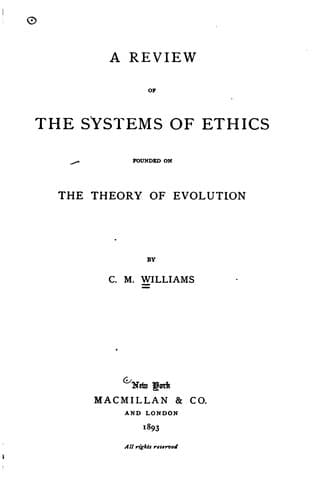
A Review of the Systems of Ethics Founded on the Theory of EvolutionWilliams, Cora May
Philosophy
A Review of the Systems of Ethics Founded on the Theory of Evolution
Williams, Cora May
Ethics, Evolutionary
Human beings, as plastic shapes, moulded by contact, adjust themselves
to each other, and thus it comes about that certain personal claims are
waived. Self-sacrifice is a real fact, a fact attested by the existence
of the bad, to whom such sacrifice involves a loss of happiness and is
impossible. It means the abandonment of a real good which the individual
would seize under other circumstances. It is sometimes contended that
real self-sacrifice is impossible, either (1) because the sacrifice is
really pleasanter to the agent, or (2) because he is compensated for his
loss. But the evident fact that self-sacrifice is pleasanter to the
agent does not involve the seeking of his own pleasure by the agent, and
even if it be admitted that there is always the forecast of compensation
in the mind of the agent, yet part of the forecast is the picture of
happiness foregone. But here, as before, it may be said that the element
of reflection, the weighing of one's own and others' happiness against
each other is read into the act by the onlooker, and is not necessarily
involved. That his own self-sacrifice, the compensation of his own
consciousness of right-doing outweighs, to the moral man, the pleasure
of lower aims, does not mean that the individual is selfish in seeking
self-sacrifice. And, in fact, that any ulterior aim of self-satisfaction
beyond the act itself is sought, in self-sacrifice, by the moral man, is
false; the greatest acts of heroism are characterized by complete
absorption in the impersonal end sought, the good of the agent thus not
lying beyond, but consisting in his action. Acts characterized by
another spirit than this we do not term self-sacrifice.
As all conduct is a matter of will, so morality is concerned not merely
with the virtues, the practical dealings of men, but also with all that
strengthens or weakens the will and, in general, conduces to character.
In judging a man, the significance of his individual gifts, and the
responsibility which attends the cultivation of these gifts must be
recognized. Not special virtues alone must be considered, but the whole
man must be judged and the significance of his self-cultivation in this
or that direction observed. This does not mean that the exceptional
faults of exceptional men are to be condoned. On the contrary, there is
no reason to suppose that special gifts confer a special privilege
rather than a special responsibility. Judged in the entirety of their
character, such men may not be worse than others, and this fact should
be regarded; but we should not defend their sins as such. The neglect of
self-cultivation in one direction may be necessary to action in another
direction; but the moral criterion of such self-cultivation or action is
to be found in morality as an equilibrium of powers.
Public-domain text, read in full here on John Shaqi.
Reviews
Reviews
No reviews yet
Be the first to share your thoughts on this work.
Elsewhere in the archive
Join the Discussion
Join the discussion
Sign in to leave a comment or review.
Sign InorCreate an account