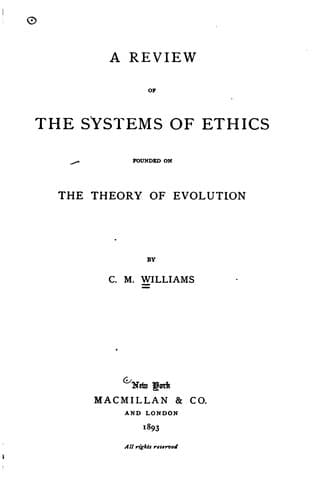
A Review of the Systems of Ethics Founded on the Theory of EvolutionWilliams, Cora May
Philosophy
A Review of the Systems of Ethics Founded on the Theory of Evolution
Williams, Cora May
Ethics, Evolutionary
Perfection is not itself sufficient to define the end. Perfect is that
which is the best possible; perfection as a perfect activity rather
than a perfect state (as we must conceive it) is equivalent to the best
possible conduct. But the moral end can be understood as perfection only
when by the best possible conduct is understood that which is the best
possible under circumstances determined by morality itself. The fullest
development as demanded by morality is not necessarily the perfection of
development in any particular case, that is, with regard to any
particular gift or individual. Or, in other words, perfection in both
its absolute and its comparative meaning, is a conception which belongs,
not to morality as such, but to the materials out of which morality is
constituted. Take "perfect" as equivalent to "best," then perfection is
equally involved in every good action. The good is always the best; what
is right is perfect; morality discards degrees of comparison. But the
degree of perfection to which any power or individual is to be developed
is determined, morally, by the principle of equilibrium. Moreover, we
may recognize degrees of perfection in individuals who are,
nevertheless, not to be classified as of less or greater moral value.
There are two different conceptions of merit, the one as applied to
magnitude of actual achievement, the other to magnitude of effort. The
apparent discrepancy vanishes on reflection, since both conceptions
apply to what passes beyond the average and measures the distance
between the two.
Public-domain text, read in full here on John Shaqi.
Reviews
Reviews
No reviews yet
Be the first to share your thoughts on this work.
Elsewhere in the archive
Join the Discussion
Join the discussion
Sign in to leave a comment or review.
Sign InorCreate an account