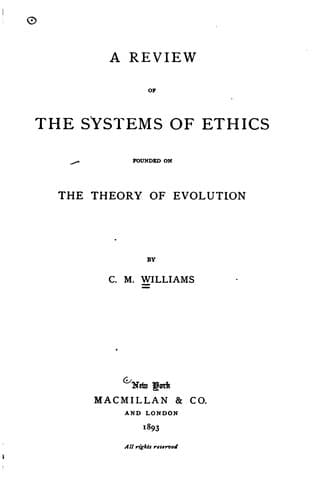
A Review of the Systems of Ethics Founded on the Theory of EvolutionWilliams, Cora May
Philosophy
A Review of the Systems of Ethics Founded on the Theory of Evolution
Williams, Cora May
Ethics, Evolutionary
Against the hedonistic doctrine, it has been urged by Green that
pleasure as such is not the end of action, for even where the single
pleasure is desired there is always the thought of a permanent self
whose good is supposed to lie in the direction of this pleasure; while a
sum of pleasures cannot, as such, be an object of desire, since
pleasures, as separate and transitory in contradistinction from the
permanent self, cannot be added together in fact, but only in thought;
and with regard to a greatest sum of pleasures the difficulty is still
greater, since pleasures admit of indefinite increase, and their sum can
never be the greatest possible. In so far as desire is supposed to be
for pleasures and nothing else, the argument that a sum of pleasures
cannot be desired must be admitted. The transiency of the pleasures has,
however, nothing to do with the question; the reason why a sum of
pleasures cannot form a single pleasure is that they are pleasures with
a higher idea--that of a series involving a plan. This does not prove
that a sum of pleasures might not be the criterion of conduct. It must
be admitted that "sum" is an unfortunate word, since it seems to imply
that the pleasures must be combined in one total result; but such an
interpretation of the word is not necessary. A series of pleasures is
properly nothing more than an aggregate or combination of pleasures,
partly successive, partly coexistent. Nor does the greatest possible
happiness mean a happiness than which no greater is possible, but the
greatest possible under the given conditions. The polemic is directed
against the individualistic psychology, which regards mental states as a
mere succession of events. So far the arguments enforce a great
principle; a mere succession of feelings or sensations could never yield
a conception of a sum apprehended as a sum. But this is irrelevant. For
such an idea we require much more than sensation: we require memory,
perception, the idea of a self. But this is only saying that morality
requires more than mere sensation, and the argument assumes the
standpoint it is fighting, treating mental states as mere events. It,
moreover, introduces the idea of a permanent self as something superior
to mere sensations, whereas perhaps this self is elaborated from
sensational elements. Furthermore, if the proposition means that a mind
which had only sensations could not have a sum of sensations, this may
be denied. A sum is possible from three positions--that of the
conception of a spectator, that of a reflecting consciousness, and that
of a feeling consciousness which feels its states continuously, though
it may not feel them as continuous, for such a feeling would argue
comparison and reflection. The polemic, therefore, while in so far right
as it is directed against individualistic psychology, seems to assign
wrong reasons for a rejection of hedonism; Utilitarians, while speaking
of pleasures in the language of psychology, treat them really as
Public-domain text, read in full here on John Shaqi.
Reviews
Reviews
No reviews yet
Be the first to share your thoughts on this work.
Elsewhere in the archive
Join the Discussion
Join the discussion
Sign in to leave a comment or review.
Sign InorCreate an account