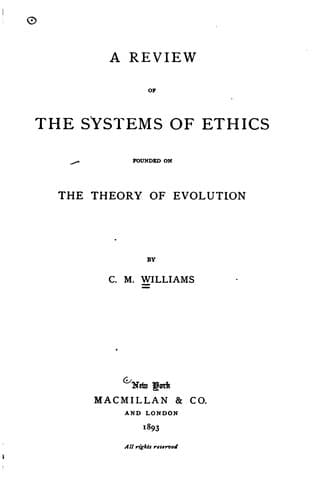
A Review of the Systems of Ethics Founded on the Theory of EvolutionWilliams, Cora May
Philosophy
A Review of the Systems of Ethics Founded on the Theory of Evolution
Williams, Cora May
Ethics, Evolutionary
something more than mere events--treat them as we really combine them by
processes much higher than sensation. A refutation of hedonism must
consist in showing that pleasures really differ in kind, and cannot,
therefore, be compared in intensity. "Pleasure" is often used as
equivalent to a pleasant sensation; such pleasures differ in kind, as in
the case of gratified hunger, ambition, and the like, and cannot be
actually added, either in thought or in enjoyment, because
incommensurable. "Pleasure" is often used, also, to refer, not to the
sensation itself, but to its pleasantness, and here the same thing is
true; if we distinguish the quality and the tone of feeling, as usual in
psychology, the classification of tones as pleasurable and painful is
insufficient. "The tones of colors and sounds, for instance, are more
naturally represented by the mood of mind they suggest: red has a warm
tone, black a sad, gray a sober, the organ a solemn tone."[82] The tone
of some feelings is too indefinite for description,--a vague comfort or
discomfort,--while the tone may rise to a condition to be described only
by "bliss" or "rapture." Pleasure and pain depend, moreover, not only on
the quality and quantity of the feeling, but on the whole condition of
the mind, pleasure indicating agreement with the mind, pain
non-agreement. Every pleasure being a function of the sensation in which
it is an element, the supposed sum of pleasures must be made up of
pleasures every one of which is qualified as that which is produced by a
certain activity. "The sum of pleasures, therefore, re-introduces the
distinctions and contents of the moral order, and, though an expression
of the criterion of conduct, is therefore, like perfection, not an
independent criterion." The element of quality in pleasure may be
_verified_ more easily as what may be called _preferability_. The term
preferability does not mean that there is an inherent moral value in
every pleasure, in virtue of which pleasures may be distinguished as
higher or lower--obviously an erroneous view, for higher and lower is an
antithesis established by morality itself; the value depends on the kind
of pleasure, and the preferability is that in the good man's mind.
Public-domain text, read in full here on John Shaqi.
Reviews
Reviews
No reviews yet
Be the first to share your thoughts on this work.
Elsewhere in the archive
Join the Discussion
Join the discussion
Sign in to leave a comment or review.
Sign InorCreate an account