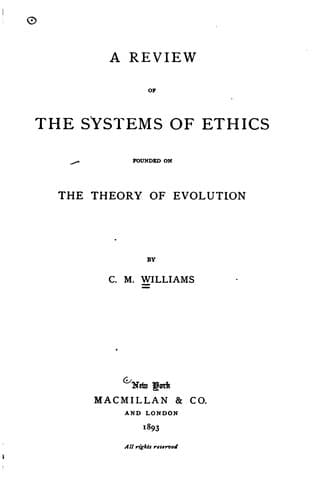
A Review of the Systems of Ethics Founded on the Theory of EvolutionWilliams, Cora May
Philosophy
A Review of the Systems of Ethics Founded on the Theory of Evolution
Williams, Cora May
Ethics, Evolutionary
It might be objected that even though pleasures differ in kind, a
comparison and summation of them might be possible, just as comparison
and summation of weights is possible, although weight depends not on
bulk alone but also on specific gravity. It cannot be denied that some
numerical expression for qualities of pleasure may yet be found, by
which they may be compared. But it is to be noted that, the higher we go
in the scale of existence, the more distinct becomes the growth of a
principle of selection or distribution which the members of a
combination must follow in order to produce a given quantitative result.
In chemistry we may obtain the atomic equivalent of sulphuric acid (98)
in many ways, but we can obtain the acid itself only by specific
combinations in specific proportions. In determining what food to give
an animal, we must consider not bulk alone but the nutritiousness of
various sorts. We might express the nutritiousness of various foods by
numbers, but the numerical equivalent would tell us nothing, unless we
knew the kinds of food to be combined. And in the same way we might
express the sum of pleasures as end numerically, but until we know the
kinds of activities and so of pleasures to be combined to this sum, the
formula is useless to inform us as to the end or method of attaining it.
The popular conception of happiness avoids all the difficulties and
perplexities caused by setting up pleasure as the end, because in that
conception pleasures and pains are never considered apart from conduct
and character. Thus, though the end involves pleasure, the criterion is
good conduct. The good conduct necessarily involves pleasure, for
conduct which only outwardly conforms to the moral rule, and in which
the agent does not take pleasure, is not really good.
The pleasure-formula thus represented as the standard of conduct is to
be distinguished, as actual ethical pleasure in the act, from the
pleasures attendant on the act as results, and which may be termed
pathological in a Kantian sense. The ethical pleasure need not be
unmixed, for the act which satisfies one part of a man's nature does not
necessarily satisfy all the other parts. But the ethical pleasure must
be present as the total reaction of character considered apart from the
incidentals of result.
Public-domain text, read in full here on John Shaqi.
Reviews
Reviews
No reviews yet
Be the first to share your thoughts on this work.
Elsewhere in the archive
Join the Discussion
Join the discussion
Sign in to leave a comment or review.
Sign InorCreate an account