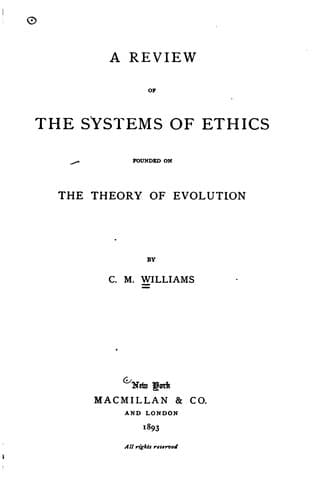
A Review of the Systems of Ethics Founded on the Theory of EvolutionWilliams, Cora May
Philosophy
A Review of the Systems of Ethics Founded on the Theory of Evolution
Williams, Cora May
Ethics, Evolutionary
Pleasures and pains may be divided into two classes, active and passive;
active pleasures being those attendant on an act, as gratification of an
impulse, passive pleasures those which come to us as enjoyments, not as
the gratification of the impulse producing an act, though perhaps
resulting from our act. Active pains are those of want, passive those of
suffering. The pleasures accompanying an act as pleasures of attainment
are always pleasures of gratification, but not of gratification merely,
for they gratify a sentiment directed towards an object previously
present to the mind in idea; and it is because the volition realizes the
idea that the pleasures are called pleasures of attainment, and in this
fact lies also their ethical value. The ethical pleasure in the action
itself is not to be confused with the mere pleasure in the explicit
consciousness of right-doing, which argues special reflectiveness. The
ethical pleasure meant is identical with the feeling of approbation, not
as a reflection on the act as idea, but as present in the act itself.
But the ethical pleasures are not independent of the incidental
pleasures, but depend upon them, the latter themselves being considered
in determining what acts are to be performed.
The pleasure-formula of the end represents the end in terms of all the
ethical pleasures secured by good action; and now we can see how
morality can be expressed in terms of all the pleasures and pains
involved in action, the purely ethical pleasures being reckoned among
the rest. Every pleasure is an inducement to persistence, every pain an
inducement to change; hence, since the society of good persons, or the
kingdom of powers within a man's own mind acquiesce in the moral order
as the equilibrium in which all their claims are gratified as far as may
be, it follows that the order of good conduct represents the maximum of
happiness. The end thus _involves_ the greatest happiness of the
greatest number.
Public-domain text, read in full here on John Shaqi.
Reviews
Reviews
No reviews yet
Be the first to share your thoughts on this work.
Elsewhere in the archive
Join the Discussion
Join the discussion
Sign in to leave a comment or review.
Sign InorCreate an account