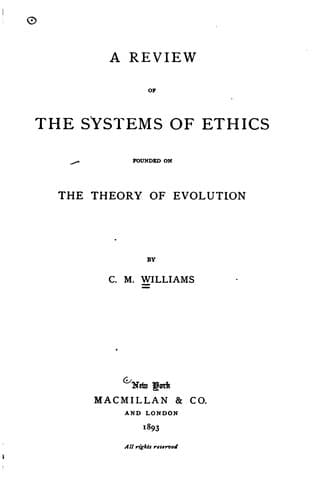
A Review of the Systems of Ethics Founded on the Theory of EvolutionWilliams, Cora May
Philosophy
A Review of the Systems of Ethics Founded on the Theory of Evolution
Williams, Cora May
Ethics, Evolutionary
If pleasure is but a part of the standard of morality, is it, then, the
object of conduct? If the idea before the mind to be realized in action
is called the object of the action, then in the same sense the pleasure
connected with the idea, which must be pleasant, is the object of
conduct. The difficulty in agreeing that the pleasure of the idea is
part of the object of desire arises from two causes: (1) confusion of
the object of desire with the character or criterion of the object; (2)
a misunderstanding of how the ideal object is related to the result. As
to the latter cause, it may be said that the idea is only in this sense
an idea of the result, that the result is the idea as it is realized;
the elements of the idea are derived from the past, and the desire is
not for the prospective pleasure of the end. As to the first cause,
though it is false that the prospective pleasure must necessarily be
part of the idea, the opposite conclusion is not necessarily legitimate
that desire is not for pleasure at all. It is true that, in order to
distinguish one object from another, we need to know what kind of an
object it is; but to conclude that, therefore, the desire is not for
pleasure, is to confuse the actual idea before the mind in desire with
its quality. That we do not make pleasure an object in the sense that
the pleasantness of the object itself is what we have before us in
desire, is obvious. Such a desire would argue a reflectiveness which has
been shown not to be necessarily characteristic of action. Nor is it the
pleasure of an act which is the cause of the desire, even if we suppose
this not in the sense that reflection apprehends it as cause. To suppose
this is to confuse the cause with its sign. The pleasure is a function
of the quality of the object. The element of reflectiveness _may_ enter
into a consideration of the object, and the prospective pleasure thus
become an element of the object of desire. But it is only a part; the
pleasure alone cannot be the object of desire. The pleasure which is
thus a part of the object is not a future pleasure, but that which is
actually present in our minds, belonging to the ideal object as part of
it--the represented pleasure of attainment. To call the pleasure desired
the prospective pleasure is to confound the reflection of the spectator
with the actual fact in the mind of the agent to an act. The pleasure
is, moreover, not pleasure in general, but the pleasure of the agent;
but this is not stating that the act is necessarily selfish.
Public-domain text, read in full here on John Shaqi.
Reviews
Reviews
No reviews yet
Be the first to share your thoughts on this work.
Elsewhere in the archive
Join the Discussion
Join the discussion
Sign in to leave a comment or review.
Sign InorCreate an account