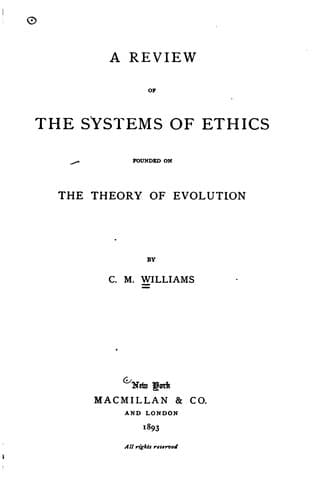
A Review of the Systems of Ethics Founded on the Theory of EvolutionWilliams, Cora May
Philosophy
A Review of the Systems of Ethics Founded on the Theory of Evolution
Williams, Cora May
Ethics, Evolutionary
Since every object of desire and will includes pleasure, the so-called
"paradox of hedonism"--that pleasure is lost by seeking after it--cannot
be explained by holding that pleasure is not itself the object of
desire, and that consequently pleasure is never, in enjoyment, what it
is in idea. This last is true, for no idea is in reality what it is as
idea. But the explanation lies rather in pointing out how foolish it is
to seek for what is a sign or effect rather than for its cause.
In the good man, the pleasure of attainment is the ethical sense of
approbation, and this is also goodness. It may, however, be asserted
that it is not this ethical pleasure, this goodness as such, that is
desired by the good man; again, it is only in exceptional cases of
reflectiveness that goodness or the right action as such is
distinctively desired; and herein lies Kant's mistake in asserting that
a moral act must be done from a sense of duty.
Active pains, as wants, are what prompt to action, and are, so, the
conditions of conduct. Though in themselves evil, as pain, they cannot
be considered by themselves apart from the action to which they lead. As
for passive pains, in so far as they are the result of evil action on
the part of others, they ought not to have occurred, and we try to
prevent their repetition by punishment. Those sufferings incidental to
right conduct are to be borne, in so far as they are inevitable, as a
necessary evil in that which, considered as a whole, is good. As soon as
they cease to be inevitable, they are to be removed. We do not imagine,
however, that pain may ever be wholly removed. But the statement that
pain is inevitable to right conduct is not to be interpreted as an
assertion that it is for the sake of goodness, as a discipline,--a
metaphysical conception depending on the idea of a divine purpose.
Public-domain text, read in full here on John Shaqi.
Reviews
Reviews
No reviews yet
Be the first to share your thoughts on this work.
Elsewhere in the archive
Join the Discussion
Join the discussion
Sign in to leave a comment or review.
Sign InorCreate an account