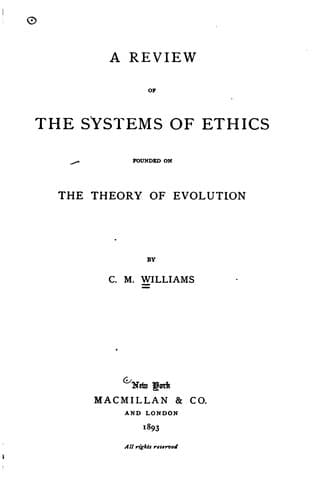
A Review of the Systems of Ethics Founded on the Theory of EvolutionWilliams, Cora May
Philosophy
A Review of the Systems of Ethics Founded on the Theory of Evolution
Williams, Cora May
Ethics, Evolutionary
Morality is thus a kind of optimism, not ignoring the reality of pains
in right conduct, but treating them as part of the given conditions
which it has to turn to the best account, by the creation of a conduct
and character involving ethical pleasures. Pessimistic theories do not
ignore this optimism of morality; but in such theories the fact of pain
is emphasized and dwelt upon, and morality is regarded only as a means
of lessening pain, or, as in the case of Von Hartmann, finally getting
rid of it altogether by a universal suicide. It is impossible to
determine whether existence represents an excess of pain or of pleasure,
since the answer to the problem is a matter of individual temperament;
and, moreover, pleasures and pains cannot be (as yet) merely
quantitatively compared. Another error of pessimism consists in
comparing pleasures and pains in detail and supposing the result to hold
good in the general sum; but even in cases where pleasures are greatly
outweighed by pains, the pains may sink in value considered in
connection with the rest of life. The desirability of non-existence
could be maintained only as a race should be developed desiring it; but
the whole course of history is in the opposite direction.
The question, Is life worth living? involves two: (1) Is it actually
preferable to the creature who lives it? (2) Can any life be said to
have a real value; is any life subjectively, is any objectively,
preferable? The answer to the first question is the fact of life, for
the mysterious instinct of self-preservation called in to account for
the continuance of existence is one of the elements to be considered in
the problem, cannot be excluded. It is true that only certain kinds of
life are preferable, but the very meaning of the principle of selection
is the securing of the life that is worth living.
Having arrived at this answer, we can no longer compare existence and
non-existence in respect to preferability, and the second problem
presents itself to us as the question as to what existence is of value.
The answer is the moral life, goodness, as including all the activities
of character.
Public-domain text, read in full here on John Shaqi.
Reviews
Reviews
No reviews yet
Be the first to share your thoughts on this work.
Elsewhere in the archive
Join the Discussion
Join the discussion
Sign in to leave a comment or review.
Sign InorCreate an account