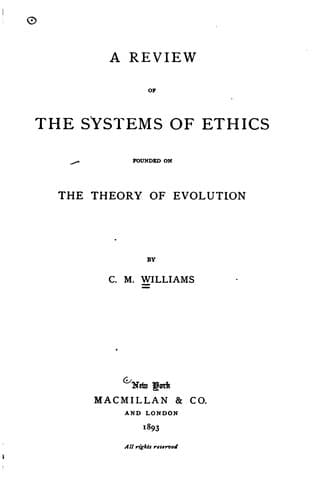
A Review of the Systems of Ethics Founded on the Theory of EvolutionWilliams, Cora May
Philosophy
A Review of the Systems of Ethics Founded on the Theory of Evolution
Williams, Cora May
Ethics, Evolutionary
The moral end has sometimes been defined as social vitality. Vitality
is, in strictness, the energy to live, and has two aspects. It is (1)
the force which keeps a creature alive, or (2) the force which keeps it
well. As implying the keeping up of vital functions, the notion of
continued existence represents the end, but represents it in its lowest
aspect, its least and poorest significance, and is an insufficient
description; for not existence can be the end, but existence of a
certain sort. "Existence, in fact, is an abstraction to which nothing
corresponds in experience: nothing exists except upon certain terms.
Given the type, the end of the creature is to continue the existence of
that type; but continuance of existence is nothing more nor less than
the performance of those functions which constitute the type of life in
question: it is not separated from those functions as something which
they subserve." If the functions in man or animal are said to be
determined by the need of maintaining his existence, it may be answered
that his existence is these functions. In this sense of continued
existence as the repetition of vital functions in their order, it is
true, but only secondarily true, that the end is to preserve life. But
the doctrine of evolution implies much more than such preservation. It
means the victorious continuance of life. But because a type is
victorious, we cannot infer that the end of the type is to maintain its
victorious existence in the sense of aiming at victory. To do this is to
read into the end a theory of how the type came into existence. The end
of a type is to act according to the type; the victory over rivals
affords the opportunity of this. The preservation of existence is a
condition of the end, not the end itself; to regard it as such is to
confuse cause with effect.
Vitality as health, on the other hand, implies the equilibrium which
constitutes good conduct good. It must, however, "be observed that
health is not a further specification or a limitation of continued life,
but is coextensive with it."
But health, as applied to morals, is a metaphorical term. Morality does
not consist in mere physical vitality; on the contrary, some sacrifice
of such vitality may be necessary, the perfect physical vitality may be
inconsistent with the development of higher and finer mental functions.
"With this proviso, vitality as health is simply another name for the
character of good conduct which wins it the title of good."
Public-domain text, read in full here on John Shaqi.
Reviews
Reviews
No reviews yet
Be the first to share your thoughts on this work.
Elsewhere in the archive
Join the Discussion
Join the discussion
Sign in to leave a comment or review.
Sign InorCreate an account