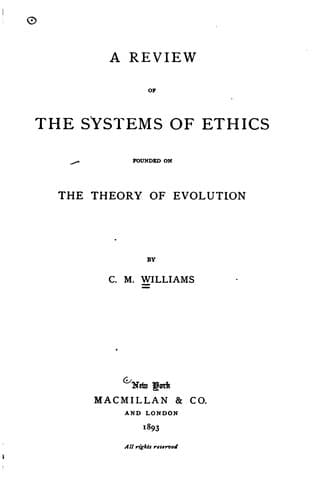
A Review of the Systems of Ethics Founded on the Theory of EvolutionWilliams, Cora May
Philosophy
A Review of the Systems of Ethics Founded on the Theory of Evolution
Williams, Cora May
Ethics, Evolutionary
There is often a distinction made between virtue and duty, the former
word seeming to include the latter and go beyond it. However, it is not
only virtuous to do one's duty, but it is also the duty of the
individual to do his best. In fact, the two, virtue and duty, are
coextensive, the term "virtue" describing conduct by the quality of the
agent's mind, the term "duty" by the nature of the act performed.
Nevertheless, there are actions to which it is more natural to apply the
term "virtue," "duty" being colored by legal implications. In the legal
sense, duty fixes, not the highest line of conduct, but the lowest
limit, beneath which conduct must not fall. Virtue, as contrasted with
duty in the legal sense, seems to be coextensive with merit. Negative
merit, however, where a man is good in spite of some great disadvantage,
does not make an act virtuous in distinction from dutiful conduct. It is
the duty of a man with a passion for drink to repress it; but we do not
term his performance virtuous, though it may be meritorious. Merit, that
is, implies a scale within the range of good acts themselves. Virtue and
duty coincide, however, only so long as the moral value of actions are
considered. For we distinguish two different classes of virtues, or two
senses of the word "virtue," corresponding to the distinction of ethical
and pathological, the pathological virtues being certain gifts of
emotion or sentiment, which are sometimes thought to make action more
virtuous, but do not alter its real character. "Thus, for example, the
virtue of benevolence may be thought imperfect without kindly feeling,
though a man may be benevolent without any such spontaneous movement.
Chastity, again, may in some natures be accompanied by, and flow from, a
delicacy of feeling which makes all unlawful suggestions impossible.
Now, if these emotions were necessary to their respective virtues, we
should have to admit that duty was less than virtue. But we must
maintain that they are excellences which do not alter the moral
character of conduct, and may be absent altogether and leave the agent
as virtuous as if they were present. Some persons, indeed, would say
that there was less virtue in characters which possessed these emotional
endowments.... In themselves, they are not virtues in the ethical sense,
but only 'add a lustre' to habits of will. They may even be ineffectual,
as often happens with very good-natured persons, or they may be
positively bad. Courage, for instance, we admire even in a villain. We
may conclude, then, that these excellences of disposition are only
valuable in so far as they are helps to virtue, and we praise the brave
villain on account of a quality which is of the utmost importance for
actual goodness. They enter into our ideal of the perfect or complete
character, though, if we estimate our ideal of perfection, we shall
find, I think, that we attach less value to them when they are native
Public-domain text, read in full here on John Shaqi.
Reviews
Reviews
No reviews yet
Be the first to share your thoughts on this work.
Elsewhere in the archive
Join the Discussion
Join the discussion
Sign in to leave a comment or review.
Sign InorCreate an account