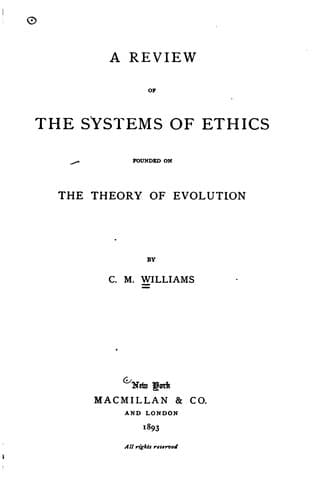
A Review of the Systems of Ethics Founded on the Theory of EvolutionWilliams, Cora May
Philosophy
A Review of the Systems of Ethics Founded on the Theory of Evolution
Williams, Cora May
Ethics, Evolutionary
"Except for the authority of one or two great names, there seems to be a
general agreement that the will is determined by character." If
character means the principle of volition, as it is regarded in our
analyses, the assertion is a truism. It is no less true if character is
defined as disposition; all our dealings with our fellow-men reckon on
their acting in accordance with their character. The distinction made by
Green that the mind acts from its own nature (the motive and the whole
process of willing being within the mind) is no more and no less true of
the action of other bodies. The emergence of new sentiments in character
might be urged as an argument for free will; but this is of no more
significance than the budding of trees in springtime. The sense of
freedom is the sense of choice between two motives; but this merely
depends upon the intellectual property that the object willed is present
to consciousness,--in case of choice two objects being present to the
mind. "So far is the consciousness of freedom from being a ground for
assuming an arbitrary or undetermined power of volition that it is
exactly what would be expected to accompany the process of determination
when the object concerned was a conscious mind. Pull a body to the right
with a force of twelve pounds and to the left with a force of eight; it
moves to the right. Imagine that body a mind aware of the forces which
act upon it; it will move in the direction of that which, for whatever
reason, appeals to it most; and in doing so it will, just because it is
conscious, act of itself, and will have the consciousness of freedom."
But which motive is chosen is fixed and dependent upon character, that
cannot choose otherwise than it does; and the sense of freedom is a
sheer delusion. The feeling that one ought to have acted otherwise
implies another sort of freedom, according to which he only is truly
free who chooses the right; in such choice it is, however, the
character which acts, and though a man is free, in this sense, _if he
chooses_, his choice is determined. The argument of free will in regard
to punishment does not explain punishment, but renders it inexplicable.
It would be senseless to punish except as, by so doing, we can influence
a man's character. Determinism does not make punishment wrong; it is not
cruelty, but kindness to punish: it saves a man from worse, from
degradation of character, enabling him to change his ideal, and thus
bringing himself into equilibrium with his kind. The reason of certain
doubts which are beginning to be felt to-day with regard to punishment
is the larger knowledge of the dependence of men on their surroundings,
hence of the culpability of society as a whole; it is not an objection
to responsibility as such, but to the distribution of responsibility.
Public-domain text, read in full here on John Shaqi.
Reviews
Reviews
No reviews yet
Be the first to share your thoughts on this work.
Elsewhere in the archive
Join the Discussion
Join the discussion
Sign in to leave a comment or review.
Sign InorCreate an account