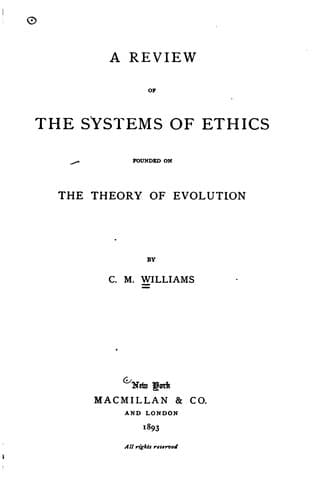
A Review of the Systems of Ethics Founded on the Theory of EvolutionWilliams, Cora May
Philosophy
A Review of the Systems of Ethics Founded on the Theory of Evolution
Williams, Cora May
Ethics, Evolutionary
Education, the second means by which the moral ideal is defended, is not
identical with social progress, by which the moral ideal is itself
changed, but is the individual progress included within each definite
moral ideal. Education and progress are, however, inseparably bound
together, in that education goes hand in hand with punishment, and in
that it leads to the discovery of new ideals. If we take only the
irregular line which includes the good, and discard the ideals which are
exterminated or left behind, the movement of ideals is continuous with
education, and progress may therefore be described as an education of
society. The education of children has to put them in possession of the
present moral achievement, and to make them independent individuals,--so
to penetrate them with the moral order that it shall appear in them as
spontaneous character. It is an evolving of an ideal already present;
for, to be capable of education, a person must have already set foot on
the right path.
As in the physical world, so in the moral, we have the survival of many
different genera and species,--various ideals of conduct or institutions
of life, some of which may be grouped together by strong resemblances,
others of which stand to each other in the relation of lower to higher
organisms; the survival of archaic institutions in the higher as well as
their history of progress showing their affinities with the lower.
"History is the palaeontology of moral ideals," and provides us with a
better means of studying the growth of morality than exists for the
study of the growth of species. As in the organic world, varieties
develop from species by a gradual and continuous movement of sentiment,
each successful variation forming the basis of a new variation, and the
differences of the varieties from each other and from the original
species increasing with their distance from the original species, until
the difference amounts to a difference of species. We may call these
modifications "accidental," but, as in the physical world, they are so
only as we regard them from the position occupied by a person before the
event; they have their causes if we can find them. These causes are to
be found in the contact of different minds. Variability depends to a
considerable extent on the size of a genus, but only in so far as
greater size involves greater complexity and variety of interests; the
vast but homogeneous societies of the East being less progressive than
the smaller but more complex ones of the West. "Where freer scope is
left to individual inclinations or aptitudes, there the friction of mind
against mind is more intense. New ideas are generated in the more vivid
consciousness of the people, and life becomes more inventive."
Public-domain text, read in full here on John Shaqi.
Reviews
Reviews
No reviews yet
Be the first to share your thoughts on this work.
Elsewhere in the archive
Join the Discussion
Join the discussion
Sign in to leave a comment or review.
Sign InorCreate an account