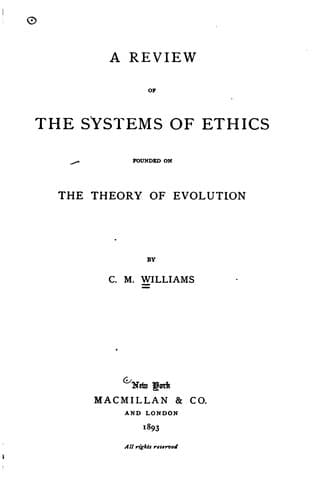
A Review of the Systems of Ethics Founded on the Theory of EvolutionWilliams, Cora May
Philosophy
A Review of the Systems of Ethics Founded on the Theory of Evolution
Williams, Cora May
Ethics, Evolutionary
Species developed from a common genus will show some common traits and
some rules of mutual observance, savage peoples which have divided into
tribes being an exception to the latter part of the statement, for the
reason that lower societies have very little moral cohesion; they may be
compared to lower organisms which reproduce themselves by fission, or to
homogeneous colonies of animals, like sponges. Under the generic
institutions we must not include those which arise merely as the result
of similar circumstances. Ideals once formed advance at very different
rates, though the tendency to divergence is always being corrected by
the diffusion of ideas. But where one nation takes ideas from another,
these ideas are not borrowed, in the sense that they come wholly from
the other nation; there must have been, in the borrowing nation, a
development of ideas up to the point that makes the borrowing
possible,--a similar development to that of the nation from which the
borrowing takes place, due to similar circumstances. The communication
of moral ideas does not depend upon race-community, as is shown by the
ready adoption of Western ideas by such nations as the Hindoos and
Japanese.
In general language, we identify development and progress; and this is
true also in the case of morality. Goodness means progress; wickedness,
retrogression or else stagnation, which, compared with advance, is
retrogression. "In changing from one form to another, morality changes
from what is right under one set of conditions to what is right under
another set, and such change from good to good is what we mean by
becoming better. To deny this is to find some other standard of advance
than in the actual movement which has taken place, to put an _a priori_
conception of development in place of the facts." "The moral ideal is
always, therefore, a progress, for either the society is single, and
goodness represents the law of its advance, or if the society is part of
a larger one, its ideal can be retrogressive only because the society is
so far bad." "And since goodness and badness exhaust the field of moral
possibilities, if the propositions that goodness means progress, and
badness regress, are both true, we must be able to convert them, and
maintain that all progress is due to goodness and all regress to
badness." To do this, we must distinguish between degradation and a mere
degeneration which involves a return to simpler conditions as an
adaptation to changed environment. Such degeneration as adaptation to
circumstances, in an individual or a society as a whole, is progress.
Fish who become blind by living in the dark become thus better fitted to
their circumstances, and the like is true of moral degeneration under
simpler conditions. Old age and death are characteristic of the higher
type of organism, in distinction from the lower types which, multiplying
by fission, are practically eternal; they are conditions of the
Public-domain text, read in full here on John Shaqi.
Reviews
Reviews
No reviews yet
Be the first to share your thoughts on this work.
Elsewhere in the archive
Join the Discussion
Join the discussion
Sign in to leave a comment or review.
Sign InorCreate an account