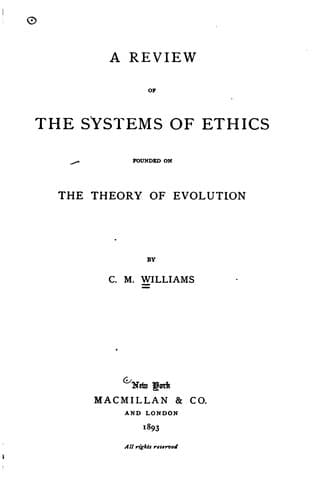
A Review of the Systems of Ethics Founded on the Theory of EvolutionWilliams, Cora May
Philosophy
A Review of the Systems of Ethics Founded on the Theory of Evolution
Williams, Cora May
Ethics, Evolutionary
In "Darwinism" (1889), Wallace advocates Weismann's theory of heredity.
With regard to instinct, he uses arguments similar to those of his
earlier work. He says of the hunting instincts of dogs: "At first sight
it appears as if the acquired habits of our trained dogs--pointers,
retrievers, etc.--are certainly inherited; but this need not be the
case, because there must be some structural or physical peculiarities,
such as modifications in the attachments of muscles, increased delicacy
of smell or sight, or peculiar likes and dislikes, which are inherited;
and from these, peculiar habits follow as a natural consequence, or are
easily acquired." So that he thus defines instinct, by implication, as
he does also in his former book, as inherited habit which has no
correlative in physical organization, and is unconnected with feelings
of liking or disliking. He further says: "Again, much of the perfection
of instinct is due to the extreme severity of the selection, any failure
involving destruction"; and adds that, even if we admit the inheritance
of the effects of the direct action of the environment on the
individual, the effects are so small in comparison with the amount of
spontaneous variation of every part of the organism, that they must be
quite overshadowed by the latter.[30] In his theory of a higher
intelligence guiding human development, Wallace seems, in this book, to
have abandoned all his former arguments except those from the mental and
moral faculties, and it is perhaps due to a perception of the
inconsistencies of his former utterances on the subject of the moral
sense that he barely touches upon it in this book. On the other hand, he
has elaborated his arguments from the mathematical and artistic
faculties, and added an argument from wit and humor, none of which are
found, he urges, among savages, except in their very rudiments, and none
of which could have been developed by natural selection, since none
could have been a cause of man's conquest in his struggles with wild
beasts or with other tribes or nations. In answer to the objection that
the law of Continuity, which he has quoted as favoring the belief in the
existence of grades of supernatural beings between man and the Deity,
tells against the introduction of new causes in man's development,
Wallace maintains that there are certainly two other points in evolution
where such new causes come into play,--namely, at the beginning of life
and at the beginning of consciousness. "Increase of complexity in
chemical compounds, with consequent instability, even if we admit that
it may have produced protoplasm as a chemical compound, could certainly
not have produced living protoplasm,--protoplasm which has the power of
growth and reproduction, and of that continuous process of development
which has resulted in the marvellous variety and complex organization of
the whole vegetable kingdom, or, that is, vitality."[31] "All idea of
Public-domain text, read in full here on John Shaqi.
Reviews
Reviews
No reviews yet
Be the first to share your thoughts on this work.
Join the Discussion
Join the discussion
Sign in to leave a comment or review.
Sign InorCreate an account