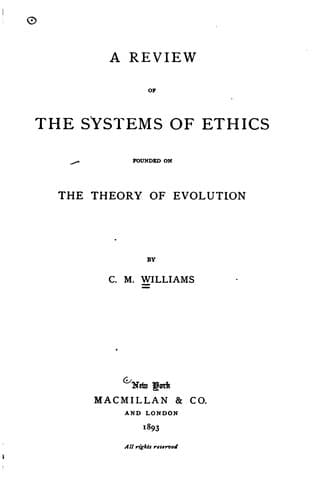
A Review of the Systems of Ethics Founded on the Theory of EvolutionWilliams, Cora May
Philosophy
A Review of the Systems of Ethics Founded on the Theory of Evolution
Williams, Cora May
Ethics, Evolutionary
mere complication of structure producing" consciousness is "out of the
question." "Because man's physical structure has been developed from an
animal form by natural selection, it does not follow that his mental
nature, even though developed _pari passu_ with it, has been developed
by the same causes only."[32] Yet, in assuming Weismann's theory,
Wallace asserts: "Whatever other causes have been at work, Natural
Selection is supreme, to an extent which even Darwin himself hesitated
to claim for it." "While admitting, as Darwin always admitted, the
cooeperation of the fundamental laws of growth and variation, of
correlation and heredity, in determining the direction of lines of
variation, or in the initiation of peculiar organs, we find that
variation and natural selection are ever-present agencies which take
possession, as it were, of every minute change originated by these
fundamental causes, check or favor their further development, or modify
them in countless ways according to the varying needs of the
organism."[33]
In the opening portions of this book Wallace introduces a teleological
argument to the effect that the pain which we ordinarily conceive as
connected with the struggle for existence among lower species is mostly
a figment of our imagination. Periods of suffering are comparatively
short, since death speedily and without anticipation puts an end to
those animals in any way incapacitated. Livingstone describes how, when
seized by a lion, a sort of stupor succeeded the first shock, so that he
felt neither fear nor pain; it is probable that terror induces this same
condition in animals seized by beasts of prey, and that their end is
therefore painless after the first shock. Cold is generally severest at
night and tends to produce sleep and painless extinction. Hunger is
scarcely felt during periods of excitement, "and when food is scarce,
the excitement of seeking it is at its greatest." Nor is the gradual
exhaustion and weakness of slow starvation necessarily painful.
FOOTNOTES:
Public-domain text, read in full here on John Shaqi.
Reviews
Reviews
No reviews yet
Be the first to share your thoughts on this work.
Join the Discussion
Join the discussion
Sign in to leave a comment or review.
Sign InorCreate an account