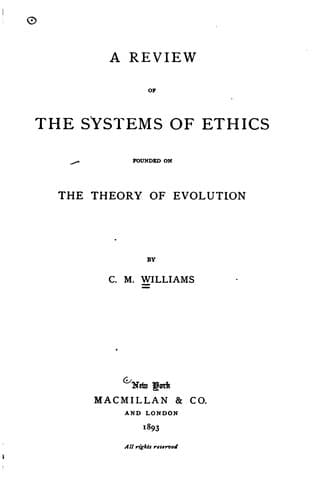
A Review of the Systems of Ethics Founded on the Theory of EvolutionWilliams, Cora May
Philosophy
A Review of the Systems of Ethics Founded on the Theory of Evolution
Williams, Cora May
Ethics, Evolutionary
In the very beginning, the theory of Evolution may be said to have had
three distinct branches, represented by the Nebular Theory in Astronomy,
Haeckel's Ontogeny, and the Biology of Lamarck, Darwin, Wallace, and
Huxley; and to these should properly be added the Sociological Ethics of
Spencer, which was not, however, worked out to a complete system. But Du
Prel says of later research: "In the progress of modern science, no
principle has proved so fruitful as that of evolution. All branches
compete with one another in its use, and have brought about by its aid
the most gratifying results. Geology interprets the significance of
superimposed, hardened strata of the earth's crust in the sense of a
history of the earth's development; Biology, in union with the study of
fossils, arranges the living and petrified specimens of plants and
animals in their order, and constructs a history of the evolution of
organic life; Philology prepares a genealogical tree of languages, and
finds in it signs which throw light on prehistoric times, and reveal
facts forgotten for thousands of years; Anthropology discovers in the
form and expression of human beings rudimentary signs that point to a
theory of development from lower forms; and, finally, History reveals
the evolution of civilization in far-distant historic times; and in all
these branches it becomes apparent that we only then understand
phenomena when we have comprehended their Becoming."[95]
It is due to the gradual perception of the fact that some such theory as
that of Evolution is implied in the very conception of the constancy of
nature that there has been a continual decrease of that negative form of
criticism which has made much of the gaps in the direct proof. Modern
science has so grown to, and by, the theory of Evolution that the
overthrow of the latter means nothing more nor less than the destruction
of science itself in its highest results. Even those who reject the
conclusions of Evolution are found to make use of its methods, and must
do so perforce. As the breadth and depth and height of the theory come
to be perceived, it is seen that the demand for complete proof is
nothing more nor less than a demand for the perfection of all branches
of knowledge, the refusal of credit without such proof a refusal to
place any confidence in the first principles of scientific theory until
it has fully explored the universe and left nothing further to be
discovered. But science would have less ground for complaint, if the
opponents of Darwinism consistently refused, on the ground of the
incompleteness of our knowledge, to form any theory whatever on the
subject of man's nature and development, permitting the worth of the
evolutional theory to be determined by its future results in application
as hypothesis. But the peculiar spectacle is afforded us of a party
rejecting a theory supported by numberless facts in all branches, and
whose very breaches the direction of discovery continually tends to
Public-domain text, read in full here on John Shaqi.
Reviews
Reviews
No reviews yet
Be the first to share your thoughts on this work.
Elsewhere in the archive
Join the Discussion
Join the discussion
Sign in to leave a comment or review.
Sign InorCreate an account