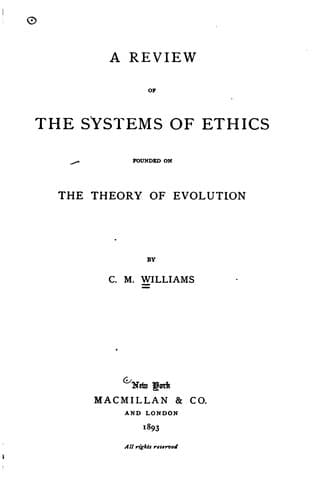
A Review of the Systems of Ethics Founded on the Theory of EvolutionWilliams, Cora May
Philosophy
A Review of the Systems of Ethics Founded on the Theory of Evolution
Williams, Cora May
Ethics, Evolutionary
bridge, in favor of a dogma which cannot point to one scientific fact in
its support,--a party demanding absolute perfection of proof as the
condition of its acceptance of one theory, while it at the same time
fiercely defends a conception of nature of which it cannot furnish the
most imperfect proof. It is true that mankind has not beheld the
evolution of the whole vegetable and animal kingdom. But neither had any
human eye ever yet beheld the planet Neptune when Le Verrier prophesied
its existence and calculated its size and position. The theory of
Evolution is a reasoning from the constancy of nature, as was that of Le
Verrier, only, in the case of the former, we have the observation and
calculations of not one scientist alone, but of thousands, on which to
rely. To demand of the scientist that he shall produce the organic from
the inorganic, and practically demonstrate the change of form and
function, and the process of separation of species, before the
possibility of such development is conceded, is on a par with demanding
of him an actual reproduction of the Glacial Period before the theory of
its previous existence shall be accepted. There is no reason for
supposing that, if spontaneous generation once took place, the peculiar
complication of conditions which produced it will ever again recur or
can be artificially constructed.
But science has no desire to be dogmatic. It readily acknowledges the
total absence of direct and established proof at this particular
juncture of the beginning of life. It can only point to the indirect
testimony of Physiological Chemistry and Crystallogeny, to the
simplicity of structure and movement in certain forms of life, and
finally to the observed constancy of nature. But an exaggerated
significance has been given to this chief flaw in the theory of
Evolution, by those who, starting with the intention of defending
Theology or the dignity of the Human, have been driven back, step by
step, to this point, and fail to perceive that, arrived here, they have
already abandoned the ground on which contest was possible. What
significance a primal creation merely of lowest organisms can have, for
either a defence of human dignity or for Christian Theology, it is
difficult to perceive. As a matter of choice, it would seem to be more
consistent with the omnipotence and dignity of a Creator to suppose that
these very simple organisms arose, like other forms, under the action of
natural law than that special interference was necessary in just their
case. But, supposing such a special Creation, the following questions
immediately present themselves from the theological standpoint: Are
these special creations endowed with soul? If so, they must be immortal;
if not, then soul arises in the process of evolution; if it arises as do
all other things, qualities, functions, by growth,--that is, by the
addition of infinitesimal increments (as we must, indeed, suppose it to
Public-domain text, read in full here on John Shaqi.
Reviews
Reviews
No reviews yet
Be the first to share your thoughts on this work.
Elsewhere in the archive
Join the Discussion
Join the discussion
Sign in to leave a comment or review.
Sign InorCreate an account