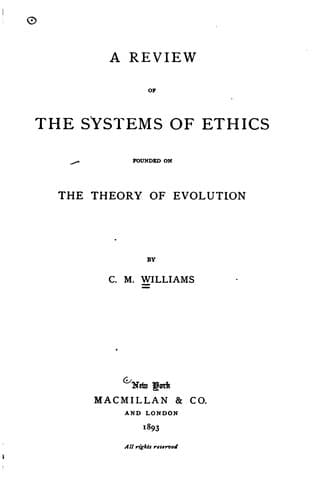
A Review of the Systems of Ethics Founded on the Theory of EvolutionWilliams, Cora May
Philosophy
A Review of the Systems of Ethics Founded on the Theory of Evolution
Williams, Cora May
Ethics, Evolutionary
"To elucidation of this principle of the Tendency to Stability," says
Dr. Petzoldt analyzing Fechner's work, "we have only to call to
remembrance a number of natural phenomena, such as the ebb and flow of
the tide, the circulation of moisture, periodic changes of temperature,
and so forth, which exhibit great periods of approximate stability and
in which we notice in general no retrogression.
"Not less does the constitution of organisms which are, 'so to speak,
constituted dependent upon periodicity of their functions, and so upon
stable relations of their life,' serve to confirm the theory. Only the
concept of stability must be extended in their case, since not always
the same, but only substitutive parts of the organic systems tend
towards stability.
"Experience never gives us an example of an isolated system; on the
contrary, every system is a part of higher systems. The inner relations
of its stability are not conditioned by its own parts only, but also,
more or less, by those of other systems, so that the destruction of one
part-system is always only in the direction towards the stability of a
higher, ultimately of the highest, system; that is, of the system of the
universe."
"Thus the teleological principle coincides with the principle of the
Tendency to Stability, and at the same time the latter constitutes the
link between the former and the law of Causality. Though, in truth, this
manner of looking at the matter signifies a generalization of the
concept of 'end,' since it defines _all_ stable conditions as ends. The
view is justified, however, by the fact that the greatest possible
physical satisfaction--for us, the criterion of teleology--is always
bound up with the longest possible preservation or slow change of a
stable organic condition. The _physical_ Tendency to Stability 'bears
with it a _psychical_ tendency to the attainment and conservation of
just those conditions' towards which the physical tendency is directed."
Of the fact that Lange "feels the lack of the proof of this 'Tendency to
Stability,'" Dr. Petzoldt says: "But how is there a need of proof here?
To prove is to refer back to known facts. But what is there in Fechner's
remarks that stands in need of such a reference? They simply draw our
attention to the result of evolution as a state which bears, in itself,
the guarantee of some continuance. Can any one contest this? Is there
anything further to prove? It is said that Gauss once remarked that
Lagrange's equations of motion are not proved, but only historically
stated. The case is exactly the same here. The fact is attested, merely,
that evolution ends in a stable condition; and herein lies the pith and
the great merit of the theory of the Tendency to Stability."
Public-domain text, read in full here on John Shaqi.
Reviews
Reviews
No reviews yet
Be the first to share your thoughts on this work.
Elsewhere in the archive
Join the Discussion
Join the discussion
Sign in to leave a comment or review.
Sign InorCreate an account